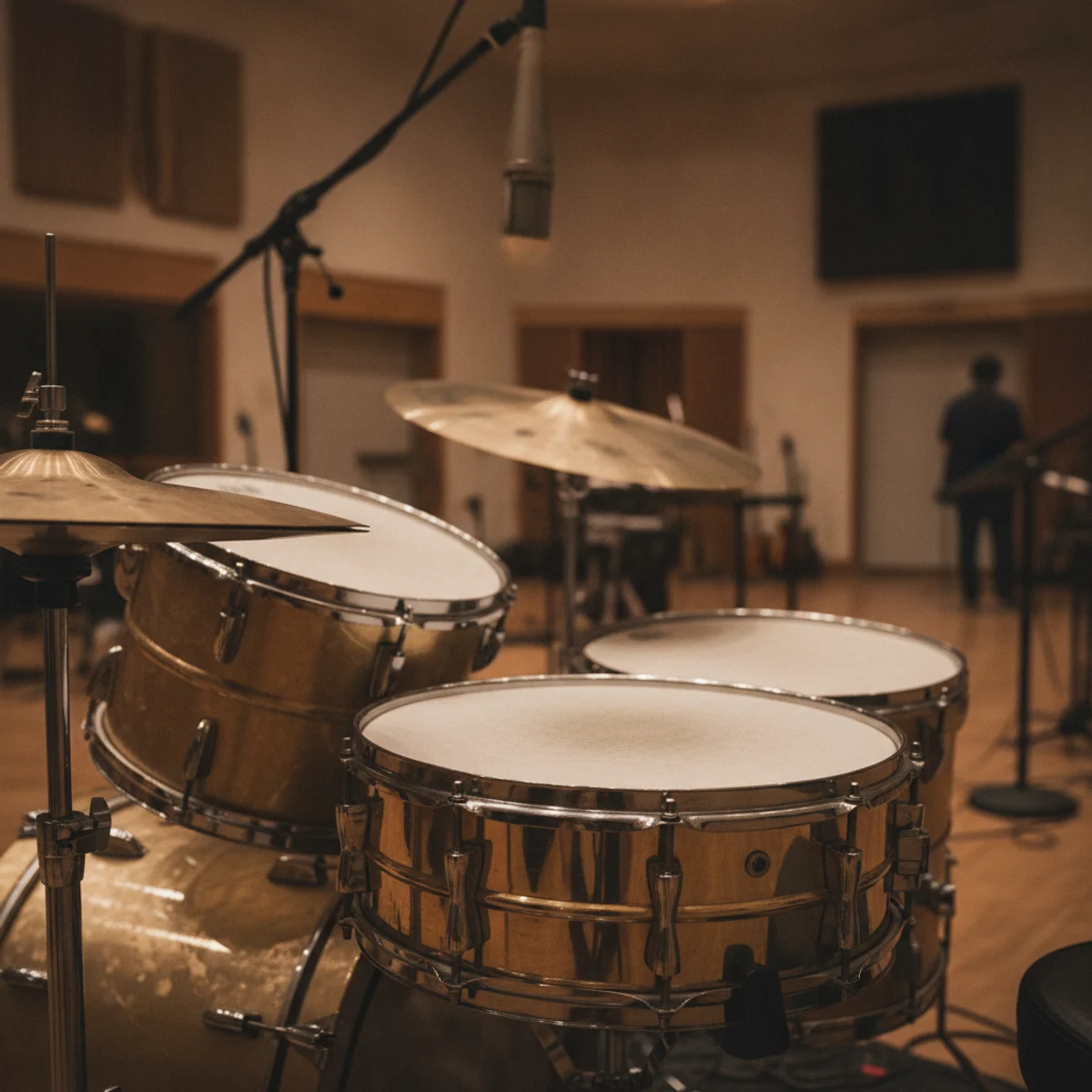
A continuous quiet sound with no transient defeats most of the usual drum recording approach.
Almost everything in drum recording is built around capturing transients. Brushes have almost none, which makes them the awkward case.
You can listen to our full playlist which contains the artist’s music, and know more about the artist’s work by scrolling down the page.

PLAYLIST
Drum Recording Is Built Around Transients
Nearly every convention in drum recording exists to capture and control transients. Microphone choice, placement, compression settings and gating all assume a source that produces short, high-energy attacks with clear starts and stops.
That assumption holds for sticks. A stick striking a drumhead or a cymbal produces exactly that: a fast rise, a defined peak, and a decay that can be shaped. The entire toolkit is well matched to the physics.
Brushes break the assumption completely. A brush swept across a coated head produces a continuous, low-level, broadband sound with no meaningful attack at all, and almost nothing in the standard approach handles it well.
The Level Problem Comes First
Brushes are quiet, and the swept sound in particular sits far below what drum microphones are usually set up to capture. Raising gain to reach a usable level brings the noise floor of the preamplifier and the microphone up with it.
That makes microphone self-noise a genuine consideration rather than a specification nobody reads. On a quiet brush passage the difference between a low-noise condenser and a mediocre one is plainly audible, because the wanted signal is not far above the noise.
It also makes the room’s noise floor matter. Air handling, traffic and computer fans that vanish under a stick performance become part of the recording when the source is a brush moving across a head.

Gates and Compressors Fail Predictably
Gating is standard on close drum microphones and is essentially unusable on brushes. A gate opens on a threshold crossing, and a continuous sweep with no transient either holds the gate open permanently or chatters as the level drifts across the threshold.
Compression fails differently. A compressor set for stick dynamics sees the sweep as steady-state material and applies constant gain reduction, which flattens the small variations that carry the pattern. The brush work becomes an undifferentiated wash.
The workable approach is usually to abandon both on the sweep and apply only gentle, slow processing, accepting that the recording will need to be clean at source because it cannot be rescued afterwards.
Overheads Do the Work
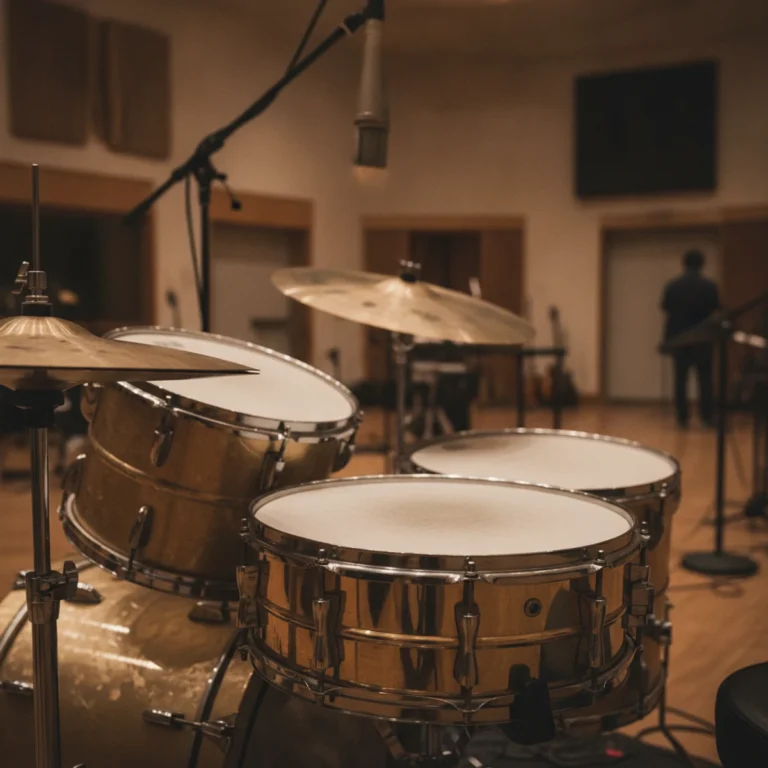
With close microphones contributing less than usual, the overhead pair carries most of a brush performance, which inverts the normal hierarchy of a drum recording.
That argues for placing overheads with more care than usual and for treating them as the main pair rather than as cymbal microphones. A slightly lower, closer position than would suit stick playing typically gives the sweep enough body to sit properly.
The snare microphone changes role too. Instead of delivering the crack of a rimshot it is capturing the texture of the brush on the coating, which usually means less compression, less high-frequency emphasis and a position further from the head than stick work would use.

The Head Is Part of the Instrument
Brush playing depends on a coated head, because the coating is what the brush is dragging against. A clear head produces almost nothing under a sweep, and the difference is not a matter of tone but of whether the sound exists.
Coating wears. A head that has been played hard with sticks has smooth patches, and a brush crossing one produces a dropout in the middle of the sweep that is audible on a recording and impossible to correct.
Serious brush sessions therefore treat head condition as a setup item on the same level as tuning. It is one of the few cases where a consumable determines whether the recording can be made at all.
Why It Is Worth the Trouble
Given the difficulty, the reasonable question is why not simply record the pattern with sticks and reduce the level. The answer is that the sound is not a quieter version of anything; it is a different mechanism.
A brush sweep produces a continuous bed of sound against which the taps and accents register as events. That relationship between a sustained texture and small punctuations is what makes brush playing work behind a ballad or a quiet solo.
No amount of processing on a stick performance produces it, which is why the technique persists in jazz despite being the hardest thing on the kit to capture. The difficulty is the price of a sound with no substitute.









About The Author