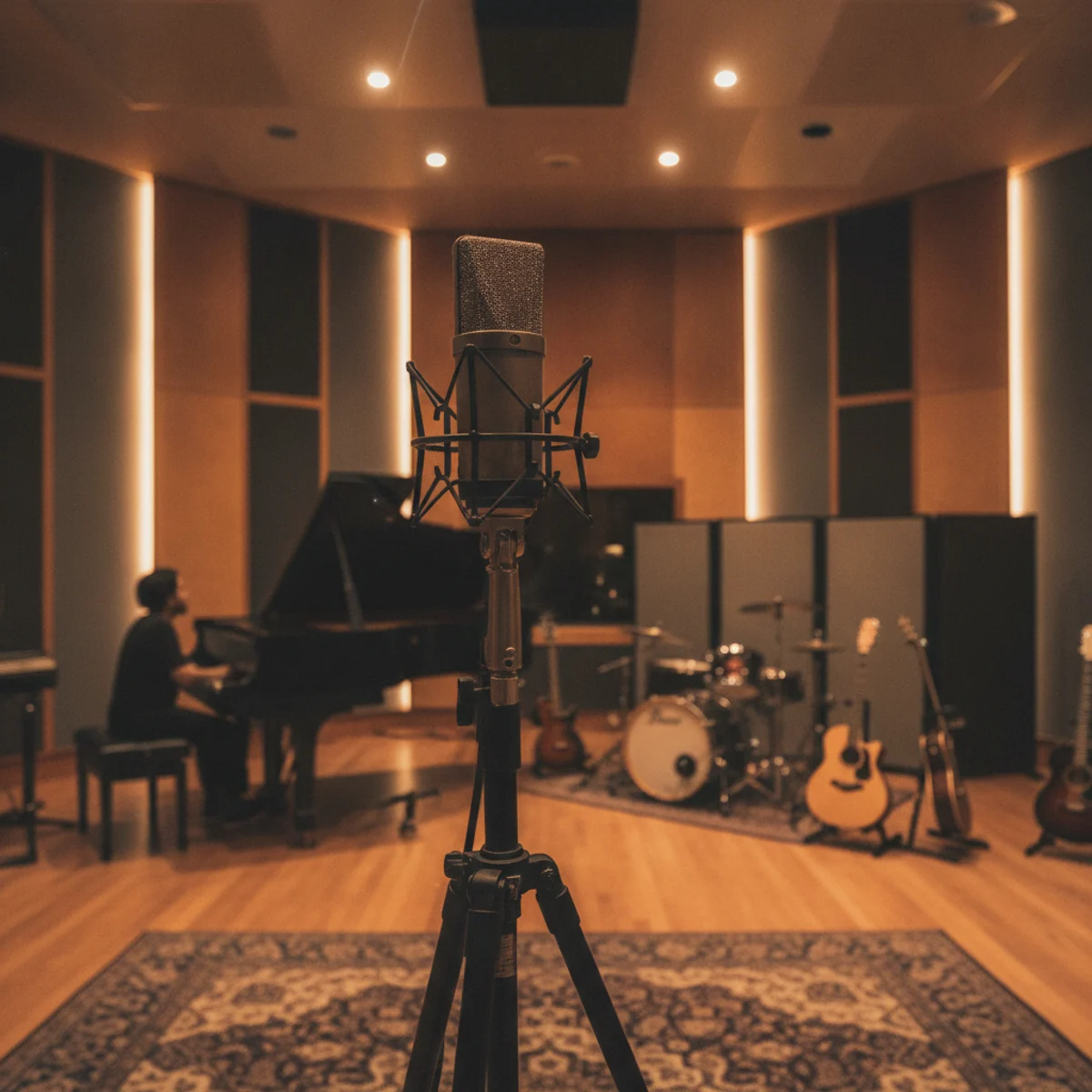
A main pair carries the recording. Everything else is a supporting decision.
Orchestral recording is usually described as complicated. The structure is actually simple: one main pair does most of the work, and everything else supports it.
You can listen to our full playlist which contains the artist’s music, and know more about the artist’s work by scrolling down the page.

PLAYLIST
One Pair Does Most of the Work
The mental model that makes orchestral recording tractable is simple: a single stereo pair placed correctly is the recording. Everything added afterwards exists to support that pair, not to replace it. Sessions go wrong most often when this hierarchy is inverted.
That main pair is typically placed above and slightly behind the conductor, high enough to see over the front desks and get a reasonably direct line to the back of the orchestra. From there it captures the ensemble already balanced by the conductor, in the hall, as a single coherent image.
An orchestra is a self-balancing instrument that has been refined over centuries to work from roughly that vantage point. Recording it as one source respects that. Recording it as ninety separate sources and reassembling them is a much harder problem that nobody has asked you to solve.
Height Is the Adjustment That Fixes Balance
When the main pair is not working, the instinct is to move it forwards or backwards. Height is usually the more effective control, and it is the one that gets neglected because it is physically awkward to change.
Raising the pair increases the angle down onto the rear of the orchestra, which brings up brass, percussion and the back of the string sections. Lowering it favours the front desks and the woodwind. A change of a metre in height can rebalance a recording more decisively than several metres of distance.
There is a limit. Go too high and you begin to lose the sense of the orchestra as a horizontal spread, and you pick up more of the ceiling than the room. The workable range is narrower than the range of positions people try.
Microphone choice for the main pair is usually a decision between omnidirectional and cardioid rather than between models. Omnis have flatter low-frequency response and no proximity effect but capture more of the hall; cardioids offer more control at the cost of some warmth.

Outriggers Widen the Image Without Breaking It
A main pair alone frequently produces an image that is correct but slightly narrow, with the outer violins and basses pulled toward the centre. The standard remedy is a pair of omnidirectional microphones placed well out to either side, above the outer edges of the ensemble.
These outriggers are added at a low level, typically well under the main pair, and delayed if necessary so they do not arrive ahead of it. The goal is to extend the width and add weight at the extremes, not to become a second stereo recording competing with the first.
Used carefully the effect is that the orchestra stops sounding like it is between the speakers and starts sounding like it is wider than them. Used carelessly the same microphones hollow out the centre and produce an image with a hole in the middle.
Spot Microphones Are for Rescue, Not Balance
Individual microphones on specific instruments have a legitimate role and a widely misunderstood one. Their legitimate role is to recover clarity for a part that the main pair cannot resolve: a solo instrument at the back, a harp, a celeste, quiet woodwind under heavy scoring.
Their misunderstood role is as a balancing tool. If a section is wrong in the main pair, the correct fix is almost always to move the pair or to talk to the conductor, because raising a spot microphone changes the timbre and the perspective of that instrument relative to everything else.
Spots also need delay. A microphone six metres closer to an instrument than the main pair hears it about seventeen milliseconds early, and adding that early copy at any significant level smears the attack. Delaying spots back into alignment is routine practice and audibly worth doing.
Session pacing is dictated by the orchestra’s contract rather than by the music. Breaks are scheduled, overtime is expensive, and the recording plan has to be built around when the players are legally entitled to stop.

The Hall Is Not a Variable You Control
Orchestral recording differs from most studio work in that the acoustic is fixed and enormous. You cannot treat a concert hall. You can only choose where in it to put microphones, and choose which hall to book.
This makes the reconnaissance stage genuinely important. Walking the empty hall while someone plays, listening at different distances and heights, tells you more than any measurement. Halls have positions that work and positions that do not, and they are not always where you expect.
An audience changes it again. A full hall is significantly more absorbent than an empty one, which shortens reverberation and reduces level at the rear. Sessions recorded empty and concerts recorded full are different acoustic problems in the same building.
Simplicity Survives Contact With the Session
The practical argument for a main-pair approach is not purism, it is robustness. A session with an orchestra is expensive, time-limited and populated by people who are not waiting for you. Complexity fails under those conditions.
With a main pair plus outriggers plus a modest number of spots, there are few decisions left to make while the clock runs, and any single failure is survivable. With sixty channels, a problem is difficult to even locate before the session ends.
That is why the approach persists across decades of technological change. It is not that more microphones cannot work. It is that the simple configuration reliably produces a good recording, and the complex one reliably produces a difficult one.
A conductor who understands recording is a substantial advantage. Knowing which passages need repeating for the microphones rather than for the performance saves session time that would otherwise be spent discovering the problem during playback.



About The Author