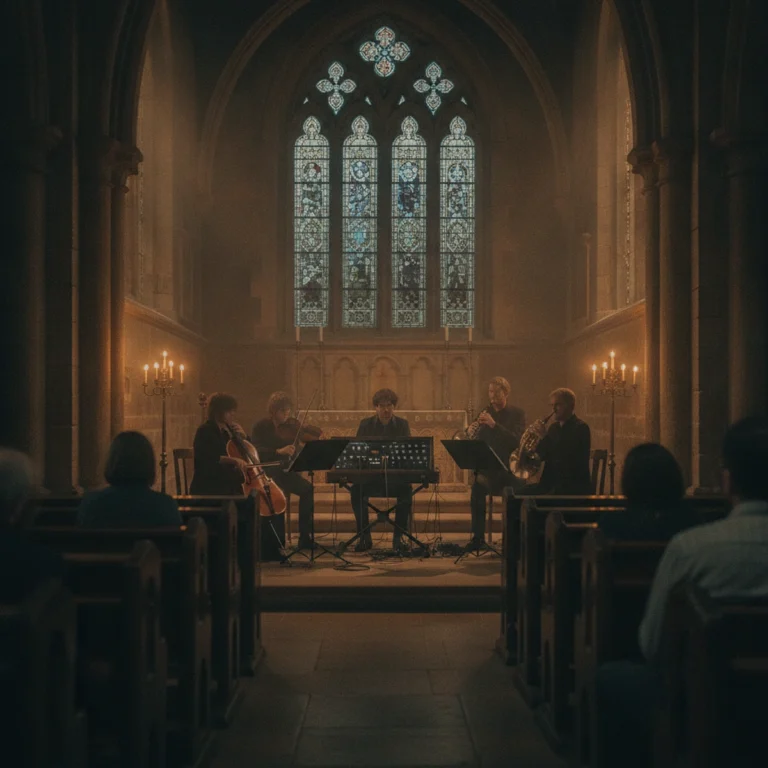
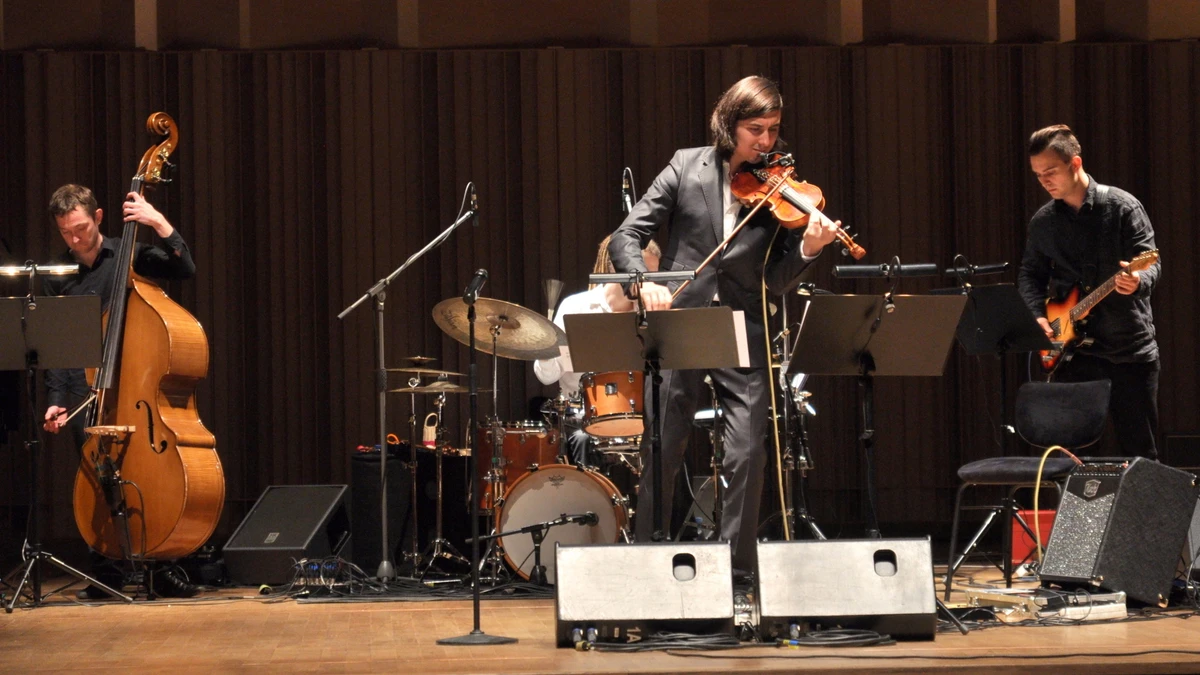
The concert hall at the Krzysztof Penderecki European Centre for Music in Luslawice was built for classical performance, which means it was built to be heard rather than to be silent. That distinction decides what a recording made inside it can sound like.
Endless, the first album by the Adam Baldych European Quartet, was made there, and the description that keeps recurring in the Polish coverage is that the hall does not merely register the quartet’s sound so much as co-create it. You can hear the air. You can hear people breathing.
Why the Choice of Room Is the First Decision
A studio is designed to give an engineer control. Absorption on the walls, a short decay, isolation between players: the point is to capture each instrument cleanly and decide later how much space it should appear to occupy. Reverb becomes an adjustable parameter rather than a fact.
A concert hall reverses that. The decay is long, fixed and shared, and every microphone hears some of every instrument. You cannot pull the room out afterwards because the room is inside every track. What you gain is that the ensemble hears itself the way an audience would, and plays accordingly.
For a quartet whose method is restraint, that trade is the right way round. If the aim is music built out of listening rather than out of statements, the players need to be able to hear each other decay. Choosing the room first is a decision other players make in the opposite direction and for the same reason: a pianist who records Bach in his own basement is also picking a space for what it does to the playing, not merely for where it happens to be.
An Unusual Set of Four
The line-up is new. Baldych plays violin and Renaissance violin, alongside the Italian bandoneonist Daniele di Bonaventura, the Swedish pianist Jacob Karlzon and the French double bassist Michel Benita.
There are no drums. In a jazz quartet that is a structural decision rather than an absence, because it removes the instrument that normally states where the beat is and hands that job to everyone. Tempo becomes something the group agrees on continuously rather than something one player supplies.
The bandoneon is the more distinctive presence. It is a bellows instrument, so its notes begin and end with a physical action rather than a struck attack, and its sustain is controlled by breath in everything but name. Put it next to a bowed violin and the two behave more like singers than like a front line. Reviewers have picked up on precisely that: di Bonaventura’s phrasing is warm and close to vocal, and the pair build melodies together rather than trading them.
What the Record Actually Sounds Like
Slow. Deliberately, and as a matter of design rather than mood.
The compositions are Baldych’s, with one exception: a reading of Erik Satie’s Gnossienne. That inclusion is a fair signpost. Satie’s writing is built from repetition, sparse harmony and a refusal to develop in the way a listener expects, and it rewards patience rather than attention.
The Paris-Move review describes an album that unfolds patiently, almost meditatively, and notes the influence of Central and Eastern European musical traditions running underneath. Not quoted folk melodies but their emotional vocabulary, which is a distinction worth keeping: borrowing a tune is a citation, borrowing a mood is a compositional habit.
Track titles carry the same intention. Long Way Home, Horizon, Wanderer, The Stars Are Closer Than We Think, Between Here and Forever. Eleven in total, closing on Michalina.
One Reservation Worth Reporting
The same review raises a criticism that belongs in any honest account of a record made this way. The double bass sits high enough in the mix that it occasionally works against the transparency of the writing, with finer details in the arrangements becoming harder to pick out.
That is described, correctly, as a question of balance rather than of playing. It is also a very familiar hazard of hall recording. A double bass in a long reverberant space produces a low-frequency field that arrives at every microphone from every direction, and low frequencies are the hardest thing to localise or reduce after the fact. Get the placement slightly wrong and the instrument becomes the room.
It is the ordinary difficulty of recording a double bass, made harder by choosing a hall over a studio. Singers and engineers name rooms for this reason, and a room described by one artist as a submarine is a description of low-frequency behaviour as much as a joke. The reviewer’s judgement is that these moments are the exception. That sounds right, and it is the price of the decision rather than an argument against it.
A Violinist Moving Away From Virtuosity
Baldych arrived internationally as a player of formidable technical command, and the change across his recent records has been a steady demotion of that command from the subject of the music to the means of it.
The Paris-Move piece puts it plainly: virtuosity was once the defining feature of his performances and has gradually become secondary to expression, with his control of tone and colour now working in service of ideas rather than display. On Endless he is described as posing questions rather than answering them, about what remains true amid constant distraction and what endures once the noise stops.
Those are large claims to hang on instrumental music, and they are the artist’s own framing rather than an achievement anyone can verify. What is checkable is the method. A player chasing spectacle does not record without drums, in a hall that blurs his own attack, next to a bandoneon that will match him note for note. Every one of those choices costs him definition and gives it to the ensemble.
Two Violins, Not One
The credits list Baldych on violin and Renaissance violin, and the second of those is not a decorative footnote.
A Renaissance violin is strung with gut rather than steel or synthetic core, carried at lower tension, and played with a shorter, lighter bow. The practical consequences are consistent: less projection, a softer attack, a quicker decay and a narrower dynamic ceiling. It is a quieter instrument that gives up carrying power in exchange for a sound with more grain in it and less edge on the front of each note.
In a dry studio those qualities are a liability, because a quiet instrument with a soft attack has to be pushed forward artificially and starts to sound thin when it is. In a hall they are the opposite. A long decay does the projecting, so an instrument that does not fight for space can simply be allowed to sound, and its attack arriving gently means it blends into the reverberant field instead of cutting through it.
Which makes the pairing of instrument and room a single decision rather than two. Bringing a gut-strung violin into a concert hall alongside a bellows instrument produces an ensemble in which nothing has a hard leading edge, and that is audibly what this quartet is after. It is also why the record would be difficult to reproduce anywhere else: the playing assumes the building.
Where It Sits
Endless came out at the end of August on ACT alongside Imaginary Music, with the label listing a street date of 25 August and retail round-ups placing it on the 28th. The quartet played the programme live the following Saturday, 29 August, at a Polish festival closing concert.
ACT has spent three decades building a catalogue around exactly this kind of pan-European group, assembled across borders rather than within a national scene. A Polish violinist, an Italian bandoneonist, a Swedish pianist and a French bassist recording in a Polish hall named after a Polish composer is that idea working as intended rather than as marketing.
Whether the record lasts will depend on something no description can settle, which is whether an album this unhurried holds a listener for its full length. What can be said now is that it was made the difficult way round: in a live room, with a group that had to hear itself, and with the sound of the building left where it fell.
About The Author