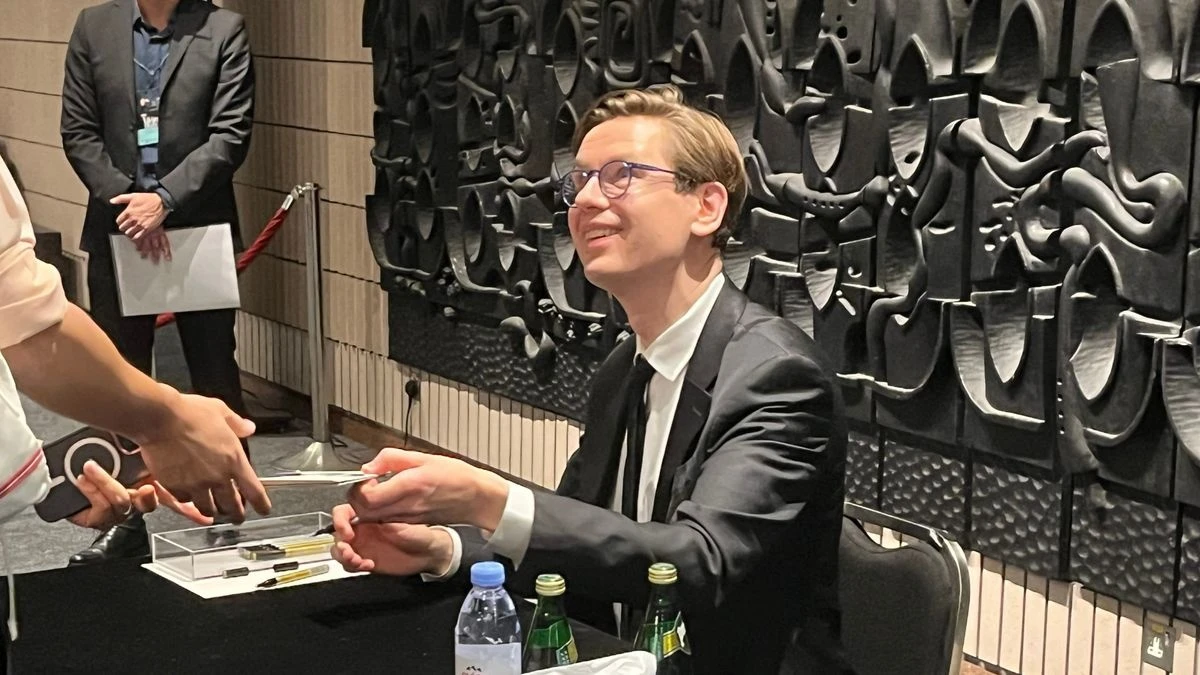
Víkingur Ólafsson at the Hong Kong Cultural Centre.
Víkingur Ólafsson at the Hong Kong Cultural Centre.
Most pianists at Víkingur Ólafsson’s level record in halls booked months ahead, with a crew and a schedule. He built a room under his house instead.
Continuum II, out on 13 November through Deutsche Grammophon, is the first album he has recorded entirely at The Nutshell — a teak-walled studio beneath his home in Iceland. His description of what that changes is disarmingly practical: “If the urge strikes, I can simply wander downstairs late at night in my pyjamas, press a couple of buttons, and start recording.”
What a Room of Your Own Does to a Recording
The classical recording process is built around scarcity. A hall costs money by the hour, a producer’s diary is booked, and a pianist arrives knowing exactly how many days exist to capture a programme. Every interpretive decision is made under that clock.
Remove it and the calculation inverts. A piece can be attempted at two in the morning because the player suddenly understands something about it, and abandoned when the understanding evaporates. What ends up on the record is what survived repeated visits rather than what was achievable in a Tuesday session.
The material suits the method. Chorales and short teaching preludes are miniatures, most of them a couple of minutes long, and a programme assembled from small pieces is exactly the kind of thing that benefits from being lived with rather than booked.
The room itself is part of the sound. Teak is a dense hardwood, and a small space lined with it gives a piano a short, warm decay rather than the long reverberant tail of a concert hall. A listener will hear this album as close and dry, which is the opposite of how prestige classical piano recordings usually present themselves.
That is a real interpretive choice disguised as a technical one. A hall recording flatters the instrument and smooths over the mechanics; a close, dry one puts the hammers and the pedal noise into the frame. On a programme of chorales written for a domestic keyboard, hearing the machinery is arguably more faithful than hiding it.
Bach Every Day, for Decades
Ólafsson’s relationship with this composer is not a project. “I have played a little Bach on the piano every day,” he told Deutsche Grammophon. “It is the one constant factor in my life, no matter what else is going on.”
He gives a reason that goes past habit. “Playing his music is a way of putting your particular experience into context with the universal.” That is a large claim, and it is also a description of what daily practice on a fixed repertoire actually does — it turns a body of music into a measuring instrument for everything else.
An album made in a home studio by a man who plays this music every morning is therefore not a document of a project. It is a slice out of an ongoing activity, which is a rarer thing to get onto a record.
Air on the G String, for a Composer Turning a Hundred
uDiscover Music lists the contents: six chorales including “Wie schön leuchtet der Morgenstern”, “Welt, ade!” and “Es ist genug”; the Larghetto from Keyboard Concerto No. 1 in D major; the Largo from the Fifth in F minor; and an Adagio from the Violin Sonata No. 5, played with the Siggi String Quartet and the bassist Xun Yang.
The first single was his own arrangement of the Air on the G String, from the Third Orchestral Suite, recorded on both grand and upright piano and dedicated to György Kurtág for the composer’s hundredth birthday. It went out on 17 July, with the Larghetto following on 14 August.
Two versions of the same arrangement on one album is an unusual inclusion, and the choice of instruments explains it. An upright is a domestic piano with a shorter, drier tone; a grand is a concert instrument. Recording the same music on both is a statement about where this music belongs, which is both places.
A Piece He Had Never Heard
The most human moment in the album’s announcement involves his producer. Christopher Tarnow suggested including “Erbarm dich mein, o Herre Gott”, and Ólafsson had to admit he did not know it.
“I had never heard this work before,” he said. “Bach wrote it when he was around twenty years old, and the first time I played it I immediately realised it was the kind of music that stays with you for the rest of your life.”
A pianist who has played Bach daily for thirty years still finding a piece he has never encountered is a useful corrective to how completeness gets talked about in classical music. The catalogue is larger than any career.
It is also the second instalment of something. His own news page lists the Bach journey as an ongoing strand running alongside everything else — the Goldberg Variations that won him a first Grammy, and the billion-stream milestone that followed. A composer he plays every morning has become, over several albums, the spine of a discography.
The other current strand is Beethoven. “Orbiting Around Opus 109” takes the late sonata as its subject, and running a Bach project and a late-Beethoven project at the same time is a particular kind of ambition — the two poles of the keyboard repertoire, worked in parallel rather than in sequence.
A Concerto Nobody Has Heard Yet
The season around the album pulls in the opposite direction from a home studio. Edinburgh International Festival took him on 22 August, and Wigmore Hall has three nights from 10 September.
Then, on 23 October, he gives the world premiere of Mark Simpson’s Piano Concerto with the London Philharmonic Orchestra and Edward Gardner at the Royal Festival Hall. A first performance is the least forgiving thing a soloist does — no recording to consult, no tradition to lean on, and an orchestra learning the piece alongside him.
Putting that in the same year as an album of Bach miniatures made in pyjamas is a fair summary of how a modern concert career actually works. The two activities have almost nothing in common except the person doing them.
Simpson is a composer and clarinettist of his own generation, and commissioning from a contemporary is the part of a soloist’s job that gets least attention and matters most. Recordings preserve a repertoire; premieres extend it, and a pianist with Ólafsson’s audience can make a new concerto heard in a way a less visible advocate cannot.
The Small Room and the Large Hall
In July his Goldberg Variations, staged with an Olafur Eliasson light installation for the Lucerne Festival, streamed on STAGE+ — a third mode again, somewhere between the recital and the installation.
The through-line is control over context. A pianist who owns his studio decides when a recording happens; one who commissions a light installation decides what a concert looks like; one who premieres a new concerto decides what enters the repertoire. It is a career built on choosing the frame rather than accepting it.
The nearest comparison is Yuja Wang withholding her recital programmes until the day of the performance — two pianists of the same generation taking back decisions that the classical industry has traditionally made on the artist’s behalf.
What arrives on 13 November is the quietest possible expression of that. Six chorales, six teaching pieces Bach wrote for students, a few arrangements, and a man who went downstairs at night to play them.
About The Author