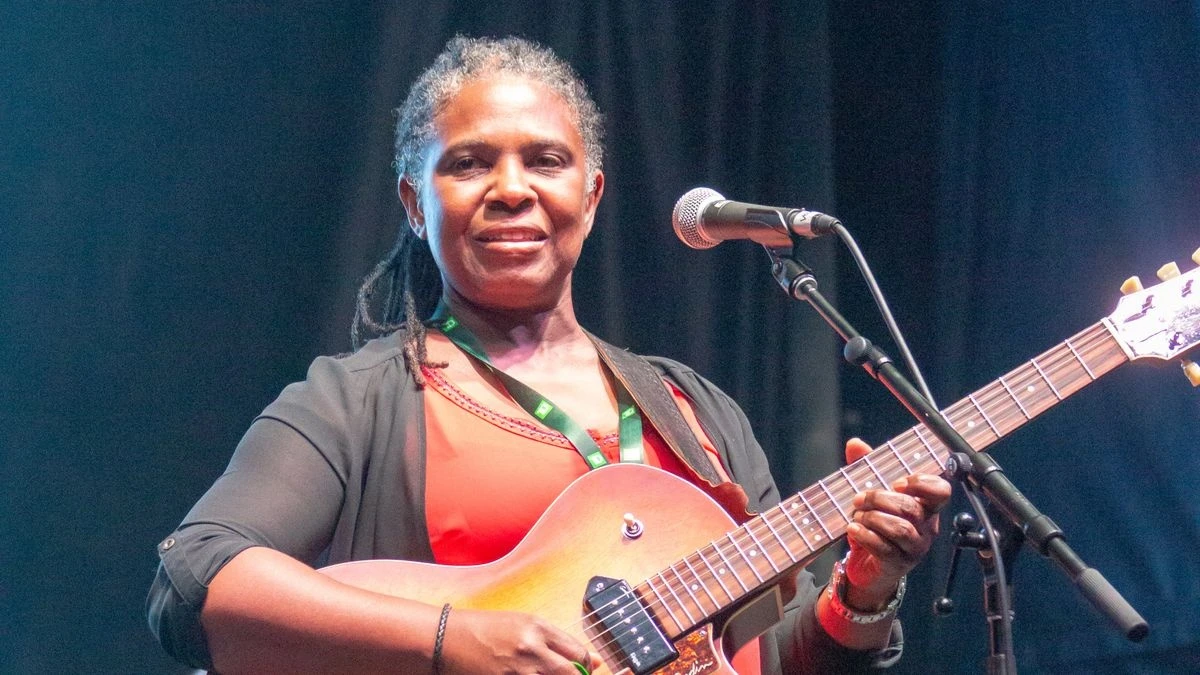
Ruthie Foster at Kitchener Bluesfest.
Ruthie Foster at Kitchener Bluesfest.
The album Ruthie Foster released today began as a note she left for herself. “I wrote this thing on a sticky note and it just said ‘Just say yes’,” she told Nashville.com.
Just Say Yes arrived on 28 August through Sun Records: ten songs, produced by Tyler Bryant at his Nashville studio, co-written with Bryant and Rebecca Lovell of Larkin Poe.
Ten Songs and Two Larkin Poes
The sequence runs “Thank You”, “Come on Up”, “Hold On”, “Yes”, “Take Time”, “Doubling Back”, “Tangled”, “Sitting Still”, “Maybe It Up” and “Reachin'”. Rock and Blues Muse lists Rebecca Lovell, Megan Lovell and Mike Seal among the studio contributors.
Bringing in both Lovell sisters matters more than a guest credit usually would. Larkin Poe are a slide-guitar act with a hard rock edge, and putting that instinct next to a singer whose reputation rests on gospel phrasing is a deliberate friction rather than a favour.
The titles trace the album’s argument in order. It opens on gratitude, moves through endurance — “Hold On”, “Take Time” — into the affirmation the record is named for, and ends on “Reachin'”. A ten-song sequence that resolves that neatly has been arranged rather than assembled.
Handing production to Bryant is the same decision in a different register. A guitarist-producer builds a record around riffs and room sound rather than around a vocal, and a singer of Foster’s power submitting to that arrangement is choosing to be part of a band rather than the front of one.
A Grammy, and a Song About Not Believing It
The first single is “Thank You”, which the label describes as blending rock, blues and gospel with high-octane riffs and rich harmonies. Its subject is imposter syndrome.
That is a pointed choice for this particular moment in her career. Foster won her first Grammy last year, Best Contemporary Blues Album for Mileage, after more than thirty years of making records — and the first song on the follow-up is about not feeling entitled to it.
“I’m amazed at how I got to this place,” she has said, and the remark reads as genuine rather than modest. An artist who spends three decades outside the winners’ circle does not acquire the reflexes of somebody who expects to be there.
Opening an album with that subject is also a structural risk. Track one is where a record establishes its confidence, and a song about self-doubt in that position asks the listener to trust an artist who is publicly announcing that she does not entirely trust herself. It works because the singing does not hedge at all.
Recorded in the Gap
The circumstances behind the sessions are unglamorous. Nashville.com reports that the record was made before knee surgery, during a period of uncertainty in her personal life — a window rather than a plan.
Foster is direct about what the touring has cost her physically. “It’s not just about age,” she said. “It’s really about the miles I’ve put on. Every step matters.” Her Grammy-winning album was called Mileage, which in retrospect looks less like a metaphor than a report.
Making an album about saying yes in the weeks before an operation is a particular kind of decision. The optimism on this record is not the untested sort; it was recorded by somebody with a surgery date in the diary.
There is a long tradition of blues records made under exactly this kind of pressure, and it is part of why the form has survived. A music built on describing difficulty accommodates an artist in difficulty better than most, and the genre has never required its singers to be having a good year.
Every Song Is About Her
“Every last one of these songs are about some aspect of my life,” she said, and the frame she gives the record is transition rather than arrival. “This was my way of being true to who I am and knowing that I’m in yet another transition in my life.”
That is a useful corrective to how a career like hers usually gets narrated. The Grammy makes a tidy ending for a profile; Foster describes it as a waypoint in a life that has kept moving, with the knee and the relationship and the new label all part of the same year.
Sun Records is worth a mention on its own. A label with that particular history taking on a contemporary blues and gospel singer is a piece of positioning, and it puts this album in a lineage rather than in a genre bin.
The Front Door, the Window and the Back Door
Her account of how she approaches a song is the most quotable thing in either interview, and it explains why her records resist categorisation. “There’s a front door, but there’s also a window and back door. There’s ways to get in. I never put any kind of constraints on myself.”
The result is an artist filed under blues who sings gospel phrasing over roots arrangements with rock guitar on them, and who has never been fully claimed by any of those constituencies. It is the same refusal that keeps Eric Bibb moving between blues, folk and soul without settling — two singers who treat the genre boundary as a suggestion.
Working with a rock producer is the current expression of it. Tyler Bryant is a guitarist first, and handing a blues and gospel singer’s tenth-something album to somebody from that world is exactly the kind of side entrance she is describing.
Gospel is the constant underneath all of it. Foster’s phrasing comes from church rather than from the twelve-bar tradition, and it is why she can carry a rock arrangement without shouting and a quiet song without thinning out. The instrument was trained for a room with no microphone in it.
Entertainer of the Year
The album lands in a year when Foster is also on the ballot for the top prize in her field. Blues Rock Review lists her among the nominees for B.B. King Entertainer of the Year at the 2026 Blues Music Awards, alongside Castro Coleman, Rick Estrin, Ronnie Baker Brooks and Vanessa Collier.
Entertainer of the Year is a live award rather than a recording one, which is the category a singer with her stage reputation should be competing in. It also sits oddly against a record made in the shadow of knee surgery — the award is for the miles, and the miles are the problem.
The touring answer to that is scale rather than retreat. The dates run from June through to March 2027, taking in festivals and AmericanaFest, which is not the diary of somebody slowing down.
The nomination sits alongside a Grammy that arrived a year earlier, and the pair of them describe a strange phase of a career: an artist who has been doing the same work at the same standard for decades, suddenly being noticed by two different institutions at once. Neither award changed the records; both changed the size of the rooms.
Whether the sticky note was advice or instruction is left open. What is clear is that an artist who spent three decades being very good without being rewarded for it has, at the point of finally being rewarded, made a record about saying yes to whatever comes next.
About The Author