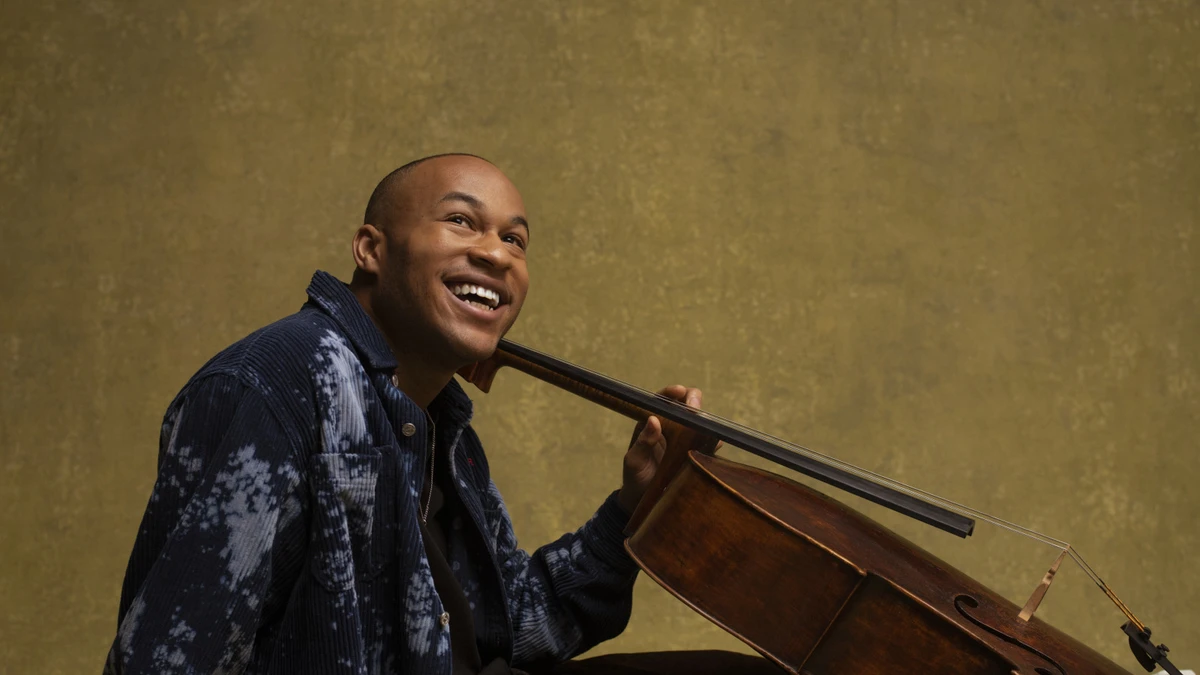
Ernest Bloch wrote Prayer in 1924 as the opening movement of his suite From Jewish Life, for the cellist Hans Kindler. It runs a few minutes, sits low on the instrument, and asks almost nothing of a player technically. Sheku Kanneh-Mason first studied it at around nine years old, which is roughly the age at which a cellist can manage the notes and nothing else about it.
It is on his ninth album, Hope in Shadow, released by Decca Classics on 13 November. Recording a piece two decades after learning it is not a nostalgic gesture in this repertoire, it is a technical decision: the notes were never the problem, so the recording is a statement about what he can now do with a line that gives a player nowhere to hide.
The Programme Is Built Around a Single Colour
The album pairs Saint-Saens’ Cello Concerto No. 1 and The Swan from The Carnival of the Animals with Bruch’s Kol Nidrei, Ravel’s Kaddish, Bloch’s Schelomo: Rhapsodie Hebraique and Prayer, and John Williams’ Theme from Schindler’s List in a new arrangement for cello and orchestra.
Kanneh-Mason described the thread plainly: “There is a darkness, a sombre and sorrowful quality that gives way to precious splashes of light.” That is an accurate reading of what these works share. Kol Nidrei, Kaddish and Schelomo all draw on Jewish liturgical material, and all three sit in the cello’s lower and middle registers where the instrument most resembles a voice.
Putting the Williams theme alongside them is the programming decision that will get noticed. It belongs to the same emotional territory, and the violin original is among the most recognisable film melodies written, but it arrived through a 1993 Steven Spielberg film rather than through the concert tradition. Transcribing it for cello moves it down roughly an octave into the range the rest of the album occupies, which is what makes the pairing hold rather than jar.
Why the Saint-Saens Concerto Is the Anchor
The Cello Concerto No. 1 was one of the first concertos Kanneh-Mason learned, which places it in the same category as the Bloch: repertoire from before the career, revisited from inside it.
It is a shrewd choice for a recording. The Saint-Saens is compact, in one continuous movement, and opens with the soloist entering almost immediately over a single orchestral chord. There is no long tutti to settle into, which means the first thing a listener hears is the player’s tone, unmediated. On a record whose argument is about colour rather than display, that entry does a lot of work.
The Swan sits at the other end of the same composer’s output: three minutes, famous to the point of being unavoidable, and almost impossible to play without either over-sentimentalising it or retreating from it. Including it on an album of liturgical and elegiac material is a risk, and the reason it works is that the piece is genuinely quiet music rather than merely gentle music.
Ravel’s Kaddish Is the Smallest Thing Here
Kanneh-Mason singled out the Ravel as “the most intimate and singular voiced work on this album”, and it is the one most listeners will not know. Kaddish comes from Ravel’s Deux melodies hebraiques, written for voice and piano, and it is essentially a single melodic line over the sparest possible accompaniment.
Transferred to cello, it becomes the closest thing on the record to unaccompanied playing. There is nothing to hide behind and nothing to balance against, and its placement among larger orchestral works gives the album a point where the scale drops away entirely.
This is the sort of programming that separates a recital record from a collection of concertos. The larger works establish a register; the small ones decide whether the record has anything to say inside it.
Edward Gardner and the London Philharmonic
The orchestra is the London Philharmonic under Edward Gardner, who has been its principal conductor since 2021 and whose recorded work runs heavily through late-Romantic and twentieth-century repertoire. That is the right match for this programme.
Schelomo in particular depends on the conductor. It is a rhapsody rather than a concerto, with no fixed formal scaffolding, and the orchestral writing is dense enough that a cello can disappear into it if the balance is not managed carefully. The piece is often described as a portrait of Solomon, and the solo line functions as a speaking voice against an orchestra that keeps interrupting it. Getting that relationship right is a matter of restraint in the orchestra rather than amplification of the soloist.
The first single from the album is the Williams theme, which is the commercially obvious choice and also the one most likely to be heard by people who do not otherwise buy cello records.
Ten Years at the Same Label
The release marks a decade since Kanneh-Mason signed with Decca Classics and won BBC Young Musician. His recordings have now passed 500 million streams.
That figure is worth sitting with, because it is not a normal number for this repertoire. Classical recording has spent twenty years managing decline, and a cellist reaching that kind of audience did not happen through the traditional channels of radio play and specialist press. It happened through streaming platforms where a Saint-Saens movement sits next to everything else a listener plays.
Ten years with one label is also unusual now. The classical major-label roster has contracted, and long relationships of this kind have become rarer as budgets moved toward project-by-project deals. A ninth album on the same imprint reflects a commercial arrangement that has worked for both sides.
Where a Transcription Helps and Where It Does Not
Two of the works here reach the cello from somewhere else, and they illustrate opposite cases. Ravel’s Kaddish began as a song, so moving it to cello is a transfer between two instruments that both sustain a single line. Very little is lost, because the piece was never harmonically busy and the cello’s range sits close to a low voice. What changes is the loss of text, and with it the loss of a listener’s ability to follow meaning word by word. The line has to carry the sense alone.
The Williams theme is the harder case. It was written for violin, and the violin’s brightness in its upper register is part of why the melody registers as fragile rather than merely sad. Moving it to cello trades that fragility for weight. The arrangement gains authority and loses a little of the thinness that made the original affecting, which is a real trade rather than an upgrade.
Bruch’s Kol Nidrei sits between the two. Bruch wrote it for cello and orchestra from the outset, drawing on the melody sung on the eve of Yom Kippur, and it is the piece on the album where the instrument and the source material were matched by the composer rather than by an arranger. Its presence gives the record a reference point: it is what the others are being measured against.
What the Record Is Actually Testing
The interesting question about Hope in Shadow is not whether the playing is accomplished. It is whether an album built almost entirely from slow, dark, vocal-register material can hold a listener across its length.
Records like this succeed or fail on variety of colour within a narrow emotional band, which is a much harder problem than contrast between fast and slow movements. The Saint-Saens concerto provides the only real momentum on the programme. Everything else asks the player to distinguish between several kinds of quiet, and between grief, prayer and reflection, which are not the same thing and are easily flattened into one another.
That is also why the Bloch inclusion is the honest centre of the album rather than a sentimental footnote. A piece learned at nine and recorded at the ten-year mark of a professional career is a measurable comparison, and the listener can hear exactly what two decades of playing did to a line that never changed.
Attention to what a room and an instrument actually produce is the through-line of this kind of record. Our recent piece on how you can hear the room breathing on Adam Baldych’s Endless follows the same question from the jazz side.
About The Author