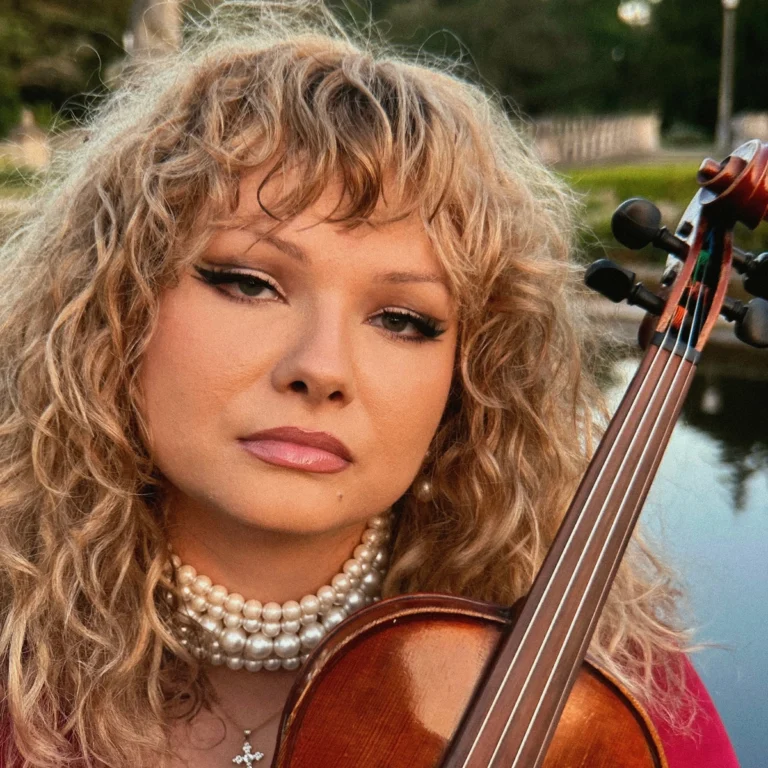
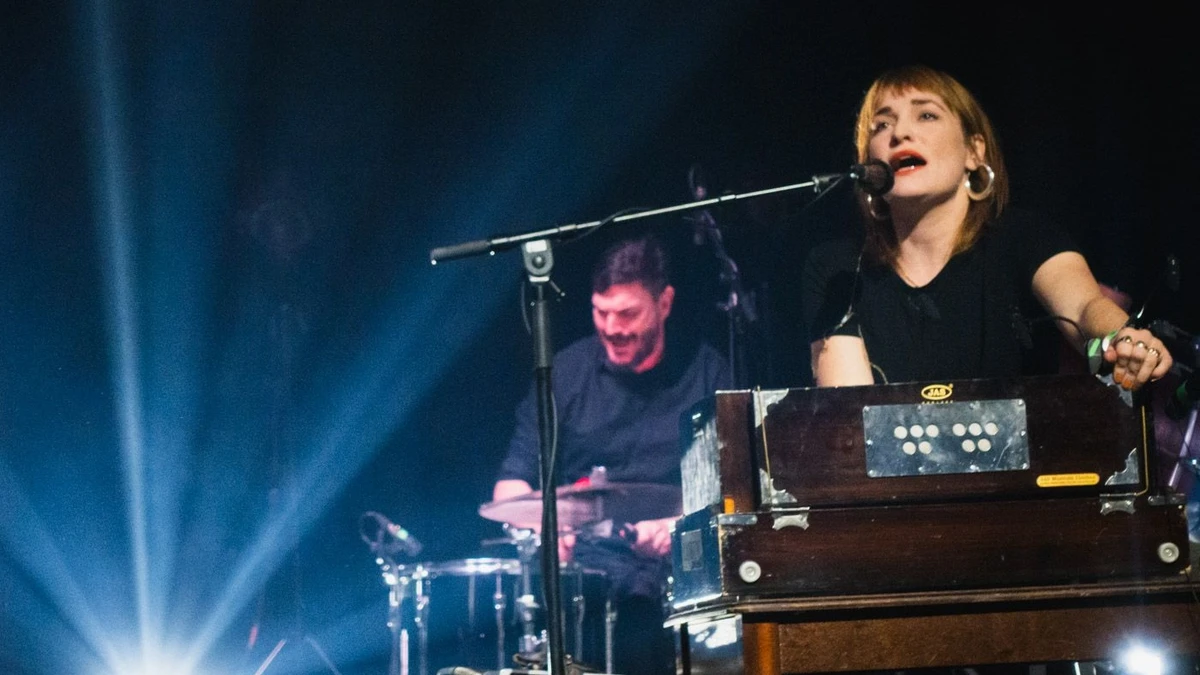
Radie Peat performing with Lankum at the Roundhouse, London, in December 2023.
Radie Peat performing with Lankum at the Roundhouse, London, in December 2023.
Radie Peat is one of the defining voices in Irish folk, but No Human Tongue Can Tell is the first record she has made under her own name. The Lankum singer releases her debut solo album on 13 November through Rough Trade Records, and she built it on a method she first saw in a documentary about Mike Oldfield making Tubular Bells: writing and playing all of the intersecting parts herself, with producer John ‘Spud’ Murphy alongside her.
The album was announced on 15 September with a second single, “The Moon and Stars”. NME called “The Moon and Stars” a haunting new single, and Uncut also reported the announcement. Here is where the idea came from, what is on the nine-song tracklist and where Radie Peat is playing it live.
The Tubular Bells Idea That Waited 15 Years
The starting point was a documentary Peat watched in her twenties. In the album announcement, quoted in full by Stereogum, she explains: “When I was in my 20s I watched a documentary on Mike Oldfield making Tubular Bells and the idea just stuck that I would like to try record like that, where you write and play all the intersecting parts.”
What appealed to her was the limitation rather than the freedom. “I found the idea of being limited by your own mind and abilities, with all the blind spots and personal preferences, very appealing, and I felt it would make something definitively unique, for better or for worse,” she says. The plan had been “ticking along in the background of my head for probably 15 years or so” before she finally made the record.
It is an unusual model for a folk singer. Lankum’s records are built from four people arranging traditional material together, and ØXN, the quartet she shares with Katie Kim, Eleanor Myler and Murphy, works the same way. Tubular Bells, by contrast, is the classic example of one musician layering almost every part of a record. Peat has taken that solitary method and applied it to songs that, by her own description, carry other people’s voices from generations back.
Tubular Bells is a fitting template. Mike Oldfield was still a teenager when he recorded it in 1972 and 1973, overdubbing most of the instruments himself, layer by layer, until one musician sounded like an ensemble. Peat applies the method to traditional songs rather than an instrumental suite, but the principle is the same: every part comes from one person’s choices, including the ones she would not have made in a room full of bandmates.
She is equally clear about who made it possible. “I’d like to thank John Spud Murphy for making this album with me,” she says. “Without his talent and patience it simply wouldn’t exist.”
Nine Folk Songs, and the Thread Between Them
The album’s Bandcamp page lists nine songs: “Hares on the Mountain”, “The Moon and Stars”, “Willow Garden”, “Luisne”, “Same Old Man”, “Dark Horse on the Wind”, “Still I Love Him”, “Bonnie Boy” and “Cailín Deas”. The record opens with “Hares on the Mountain” and closes with “Cailín Deas”, one of two Irish-language titles alongside “Luisne”. It is released under exclusive licence to Rough Trade Records, on vinyl, CD and digitally.
Peat says the collection came together easily and that she only saw the connection afterwards. “They are largely songs of female struggle, suffering, strength and endurance,” she says. “But there are many about love as well, with all the complications that brings.” She has also described singing traditional material as “communicating hundreds of years of other people’s experiences”, which binds the singer to something larger than her own life. “I’ve put a lot of myself in this album,” she adds, “and I hope it lands where I was aiming for.”
That framing matters because several of these songs are well travelled. Singing them on a solo record does not make them autobiographical; it puts her particular reading of them, and her contralto, at the centre of the arrangement.
Still I Love Him Came First
The first public step was “Still I Love Him”, released in July as her debut solo single. As KLOF Mag reported, the song reached her through the singer John Francis Flynn, who found this version in the Irish Traditional Music Archives, wrote a new melody for it and passed it on with a view to bringing its female narrator to the front.
Peat folded that melody into a layered vocal arrangement. “I like indirect,” she said. “I don’t like being too explicit and I wanted the freedom to make decisions around my voice without having to explain myself.” What she was after, she explained, was “creating emotional connection”, capturing “the elation and devastation that can accompany obsessive love”. She found the song’s archive title unsettling: Flynn had discovered it in a collection called “True Love”, a label she found dark for a song about staying with someone despite the way they treat you.
The arrangement follows that arc. Peat set the escalating behaviour of a difficult partner to “minor chords and sombre tones”, then let the chorus swell, carried by the vocals and strings and, in her words, “brimming and gushing with romance”.
Stereogum singled out the voice, describing the single as a continuation of Lankum’s spooky traditionalism carried by Peat’s bell-clear singing over a slow and spare arrangement. The video was directed by Robbie Mailer-Howat.
The single arrived at a busy moment for Lankum. Stereogum noted that the band had recently worked with Fontaines D.C.’s Grian Chatten on the soundtrack for Peaky Blinders: The Immortal Man, a sign of how far their stark take on traditional music now travels beyond folk audiences.
The Lines She Rewrote in The Moon and Stars
The second single is the more confrontational of the two. On “The Moon and Stars”, Peat rewrote parts of the traditional lyric, and she now sings: “I wish I’d never seen your face or heard your lying tongue.” In the album announcement she explains why. “There are coded references to unwanted pregnancies and abortions within the song, as well as references to rue, a herb which was used to cause miscarriage. I wanted to represent these experiences from the woman’s perspective, to connect us with her experience.”
She also traces part of the song to Irish theatre. Writing in KLOF Mag, Alex Gallacher notes her explanation that the lines about screeching and roaring recall the final scene of John B. Keane’s 1959 play Sive, in which a young woman drowns herself rather than accept an arranged marriage. The same piece points out that rue is not a new reference point for her: Peat was once part of a short-lived trio called Rue, with Cormac Mac Diarmada of Lankum and Brian Flanagan, who recorded the stark lament “Katie Cruel”.
The song opens quietly and builds to an electronic-flecked finale, and its video was directed by Peter Eason Daniels. At almost seven minutes, it shows what the Tubular Bells method can do with a single traditional melody. For a singer whose band built its reputation on drones and slow build-ups, the shape is familiar, but here one voice carries the whole structure.
The Influences She Names
Peat has been specific about the records behind the album. She lists Shirley and Dolly Collins, Enya, Lal Waterson, Katie Kim, Jackson C Frank, Karen Dalton, Nellie Weldon and Liam Weldon as the main musical influences. The last name connects directly to the tracklist: “Dark Horse on the Wind” is Liam Weldon’s song, the title track of his 1976 album, which he described in his sleeve notes as “the crystallization of my thoughts and feelings of Ireland”, as archived at theBalladeers.
The list also maps the routes she has already travelled. Lankum’s False Lankum was nominated for the Mercury Prize and an Ivor Novello award, and ØXN made CYRM with Murphy, Kim and Myler; KLOF Mag counts the two among the most talked-about Irish records of recent years. No Human Tongue Can Tell draws on both, but it is narrower in focus: one singer, one producer and nine songs.
Several of those names are singers who made traditional material sound both personal and strange, from Shirley and Dolly Collins in England to Karen Dalton in the United States. That balance between inheritance and individual voice is the one the album is reaching for.
Where to See Radie Peat Live
The live dates have grown since the first single. Peat’s show at the Union Chapel in London on 3 November is sold out, and she plays a home-city show at Vicar Street in Dublin on 20 November. In 2027 she plays Paradiso in Amsterdam on 31 January, then La Trabendo in Paris on 1 February and a larger London date at the Barbican on 19 May, the last two added with the album announcement. Tickets for those two new dates went on sale on 18 September.
The Union Chapel date falls ten days before the album is out, so London will hear the new arrangements before the record arrives. By the time she reaches the Barbican, the songs will have had six months on the road.
What to Listen for on 13 November
The obvious question is how a record made by layering one person’s parts sounds when the parts are traditional songs. “Still I Love Him” suggests the answer is restraint, with harmonies stacked for atmosphere rather than size. “The Moon and Stars” suggests the opposite, a song that gathers force until it breaks open. The other seven tracks will show which of those two modes defines the album.
It also lands in a month of records built around a single founding decision. Our report on how Max Richter turned ocean waves and gunfire into an album followed one composer letting a recorded place set the tempo. Radie Peat’s version of that idea is older and simpler: write every part, play every part, and see what a single mind produces.
This article was AI-assisted and edited for accuracy.
About The Author