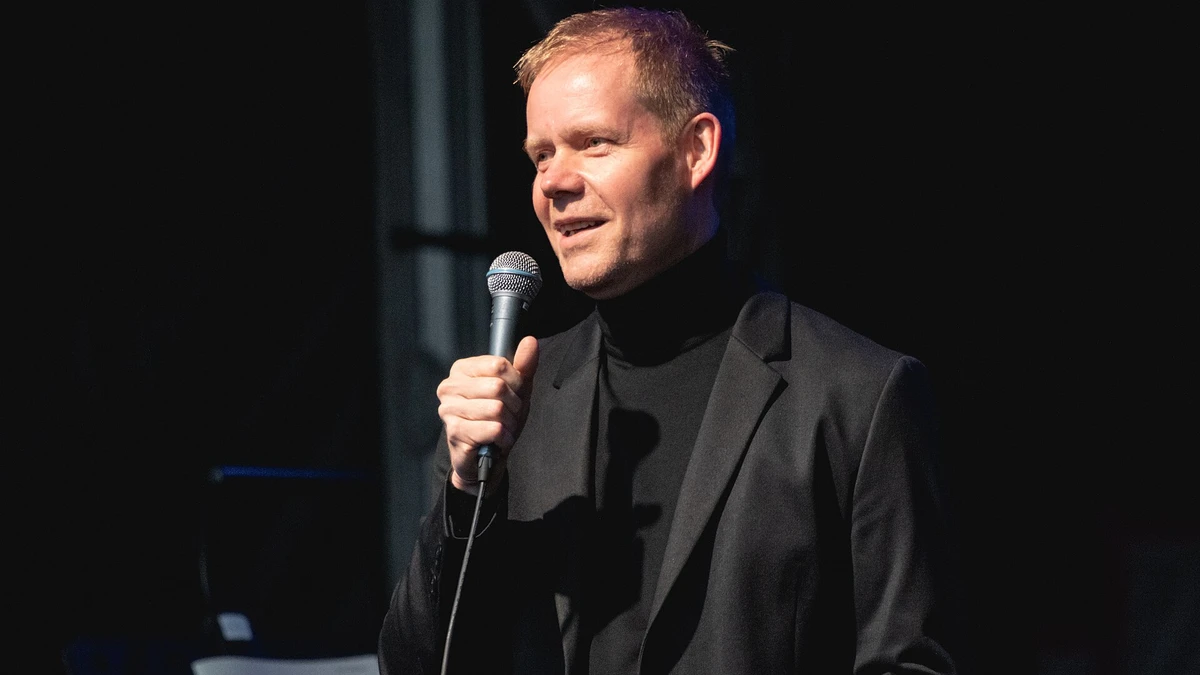
The first sound on Max Richter’s new album was recorded at the sea. On “Wave After Wave”, a processed recording of the ocean is turned into a slow, rhythmic pulse that sits somewhere between a tide and a heartbeat, and everything that follows on While the Flood Rages grows out of that decision to let a captured place set the tempo. The album, out on Friday 16 October on Decca Records, runs to 15 tracks across three acts and was recorded at Studio Richter Mahr, the composer’s base in the Oxfordshire countryside.
It is also an unusual record for Max Richter, because it began life as a ballet score and was then deliberately taken apart. Here is how it was put together, what each act sounds like, and why its release is being marked with listening rooms rather than a conventional tour.
From a Ballet Score to a Listening Record
The source is MaddAddam, Richter’s latest collaboration with the choreographer Wayne McGregor, a co-commission between the National Ballet of Canada and the Royal Opera House inspired by Margaret Atwood’s MaddAddam trilogy, according to the album announcement from Universal Music Canada. It is the third major project the two have made together, after Infra and Woolf Works.
The work was first developed before the Covid-19 pandemic and was then delayed by it, which gives the subject matter an uncomfortable timeliness: Atwood’s trilogy follows people trying to rebuild after a deadly pandemic. The album engages with ecological crisis, technological acceleration and human connection, but it is not a soundtrack. Richter describes it as a standalone companion to the ballet rather than a record of it.
“I took the material apart and created a trajectory that makes sense just through listening,” he said when the album was announced. “It’s a different way to reach the same destination.” That is a telling distinction. A dance score follows the logic of bodies on a stage. A listening record has to hold attention through sound alone, without the choreography to carry it.
Act One: The Ocean, the Machines and the City
The first act moves quickly from nature to machinery. After the ocean pulse of “Wave After Wave”, “Eerie Music” introduces a fractured electronic language built from electromagnetic recordings of the technological systems running around the studio. In other words, the hum of the building itself has been captured and turned into material, the same way the sea was at the start.
The title track then pulls the focus back to people. “While the Flood Rages” is described as a quiet, intimate counterpoint to the surrounding chaos, a piece that keeps attention on small moments of human connection while larger systems start to fail. “The City Was a Chaos” goes the other way, with dense, overlapping structures that build towards a sense of overload, before “Quiet” clears the space.
That last track matters more than its length might suggest. It introduces a simple falling piano motif that returns throughout the album, each time in a different form. For listeners who know Richter’s piano writing, it is the thread to follow: the recurring figure is how the record holds together across 15 tracks and three very different sound worlds.
Act Two: Bees, Folk Warmth and Manipulated Gunfire
The second act widens the palette. “Tell the Bees” leans towards something pastoral, with what the announcement calls an almost folk-like warmth. It gives the act a gentler opening than anything in the first.
“Data Ballistics” is its opposite. Its percussion was constructed from manipulated recordings of gunfire, and it cuts through the act with a hard, mechanical drive. Placed next to each other, the two pieces set traditional musical forms beside fractured digital textures, and the act turns on that tension between older systems of belief and a more unstable, technology-driven present.
The use of recorded sound as raw material runs through the whole album. A gunshot recording becomes a rhythm section in the same way that a sea recording becomes a pulse, and the piano, the most traditional instrument on the record, is the voice that keeps returning between them.
Act Three: Choir, Orchestra and the Returning Piano
By the final act the separate elements are brought together. Pieces such as “Dawn” and “Background Radiation” fold choir, orchestra and electronics into each other, and the falling piano motif comes back again, altered each time it appears. The effect, as the label puts it, suggests transformation rather than resolution.
The record ends with “Now We Can Sing”, which was also its first single. It was inspired directly by Atwood’s text and is built from the same recurring piano motif before opening out into a choral reflection on the human voice and on connection. NME described it as a meditative single when it was released in September, and it closes the album on something closer to quiet, collective endurance than a grand finale.
The choir is the album’s most human element. It gives the closing minutes a human scale that the first act deliberately withholds, so the album finishes on voices after starting on the sea.
Recorded in the Woods of Oxfordshire
The room behind the record is unusual in its own right. Studio Richter Mahr was co-founded by Richter and his partner, the visual artist Yulia Mahr, and sits within 31 acres of woodland in Oxfordshire. The pair farm the land and run the studio as a sustainable working environment, open to emerging and established artists developing their own work.
That setting is audible in the choices on this album. A record that begins with the sea, captures the electromagnetic hum of its own equipment and closes on a choir is, in part, a record about place and how a space can be recorded. It fits a wider interest in the recorded room that this site has followed in other artists’ work, from small home studios to the way Agnes Obel started The Meaning of Flowers on bass synths.
Listening Rooms Instead of a Tour
Richter is marking the release with what he calls the WTFR Global Listening Events, a worldwide network of small listening sessions. Inspired by the growing culture of listening bars in cities including Tokyo, London, Seoul, Copenhagen, New York and Melbourne, the events will turn cafés, wine bars and hi-fi venues into temporary listening rooms where guests put their devices away and hear the album as a whole. Further details are due to be announced.
The timing also lines up with National Album Day in the UK on 17 October, the day after release, for which Richter is one of this year’s Album Champions. He has said that albums give ideas the time and space to unfold, which is exactly the case for a 15-track record built on a single recurring motif.
Where It Sits in Max Richter’s Year
The album arrives late in a significant year. Richter was made a CBE in the 2026 New Year Honours and received the Berlinale Camera, and his score for Chloé Zhao’s Hamnet earned an Oscar nomination, as NME noted. His catalogue has passed four billion streams. While the Flood Rages follows his 2024 album In a Landscape.
The Line of Best Fit framed the release as a companion work rather than a soundtrack, and that is the right way to approach it. Anyone who saw the ballet will recognise the material, but the album asks for a different kind of attention: a single sitting, three acts, and a piano phrase to follow from the sea at the start to the choir at the end.
About The Author