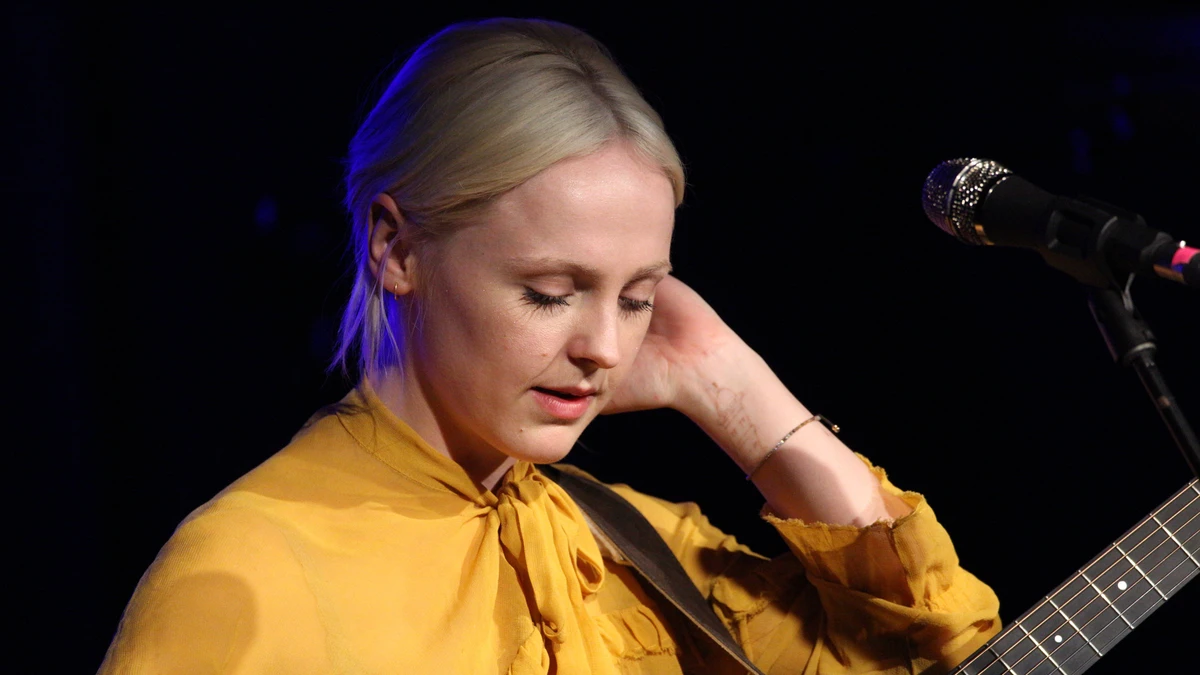
Laura Marling has been nominated for the Mercury Prize four times and twice for a Grammy. Her newest record contains a song called “Willoughby Wallaby” and another called “Biscuits In The Oven”.
Laura Sings Raffi appeared without warning on 5 June, seventeen songs long, on CD and streaming. It is a covers album of children’s music, and she is entirely serious about it.
Be Funny, Be Kind, and Never Patronise
Marling’s statement on the record is the most useful thing written about it, because it sets out a standard rather than an excuse.
“Laura Sings Raffi marks a logical next step for me, but it’s not only a desire for tolerable children’s music that landed me here,” she said. The phrase “tolerable children’s music” does a lot of work — it acknowledges the genre’s reputation while declining to accept it.
Her description of what she took from Raffi lays out the brief: “a respect for children and his expert attendance to what entertains them, but also to his wider audience — the parents whom he has blissfully attended also. Be funny, be kind, and never patronise.”
That last clause is the whole argument. Most music made for children fails on exactly that point, assuming the audience needs simplification rather than clarity, and the result is material adults endure rather than enjoy.
Writing for two audiences at once, without either noticing the other is being served, is a genuinely difficult craft problem. It is also close to what Marling’s own songwriting has always done — records about psychoanalysis, womanhood and loss that work as tunes before you notice what they are about.
She Found Raffi Before She Had Children
The origin story rules out the obvious explanation. “Having discovered Canadian songwriter and children’s entertainer, Raffi, while living in North America, I developed a love for his sincere, dead pan renditions,” she said — “all before I even had children of my own.”
That matters because a musician making a children’s album after becoming a parent is a familiar and slightly suspicious story. It usually means the record is a by-product of a life change rather than a musical interest.
Marling is describing something else: an artist who liked the work first, on its own terms, and arrived at making her own version years later.
The word she reaches for is “dead pan”, which is a revealing choice. Deadpan delivery is the opposite of the animated, over-inflected voice most children’s records use, and it implies a performer who trusts the material to be interesting without being sold.
Who Raffi Actually Is
The subject of the homage is a substantial figure. Raffi Cavoukian was born in Cairo in 1948 to Armenian Christian parents who had fled Turkey during the Armenian genocide, named after the Armenian novelist Raffi by his mother.
The family left Egypt in 1952, lived in Jerusalem and Syria, and emigrated to Canada in 1958, settling in Toronto. His father was a portrait photographer with a studio on Bloor Street; his younger sister later became Ontario’s Information and Privacy Commissioner.
The Washington Post called him the most popular children’s singer in the English-speaking world. He founded the Raffi Foundation for Child Honouring, and has campaigned on children’s rights, the commercial exploitation of children, and climate change.
That last detail reframes the covers album. Raffi is not a light entertainer who happened to write catchy songs; he is someone who built a philosophy around treating children as people, which is precisely the ethos Marling says she is honouring.
Seventeen Songs, Not All of Them His
The tracklist runs from “Peanut Butter Sandwich” and “Baby Beluga” — Raffi’s 1980 signature — through “The More We Get Together”, “Mr Sun”, “Five Little Frogs”, “Six Little Ducks”, “I Wonder If I’m Growing”, “Down By The Bay”, “One Light, One Sun”, “Robin in the Rain”, “Thanks A Lot”, “Listen To The Horses”, “Willoughby Wallaby”, “Going To The Zoo”, “Biscuits In The Oven”, “Everything Grows” and “Going On a Picnic”.
Not all of them are Raffi originals. Several are traditional or drawn from the wider children’s canon, which Raffi himself performed — and Marling has recorded those in a way meant to feel reminiscent of him rather than of the source.
That is an unusual thing to do with a covers record. She is not covering songs; she is covering an interpretation, treating another performer’s approach as the thing worth reproducing.
It also puts the record in an old folk lineage. Traditional songs have no fixed version, only performances, and choosing whose reading to follow is the central decision a folk singer makes. Our piece on guitar body size and what it does on record covers the instrument side of the same intimacy.
Several of these songs are genuinely traditional. “Down By The Bay”, “Six Little Ducks” and “The More We Get Together” predate any recording of them, passed between children before any performer put a name to them — which makes a folk singer an unusually appropriate person to be handling them.
The others belong to a canon that is barely documented. Children’s songs circulate in nurseries and playgrounds rather than through recordings, and a performer like Raffi functions less as an author than as an archivist who happened to sing well.
Seventeen tracks is also a deliberate length. Children’s records are made to be replayed rather than absorbed once, and a long tracklist of short songs is built for the way the audience actually uses it — on repeat, in a car, in the same order every time.
A Surprise Release From Someone Who Barely Tours
The album arrived with no campaign. It is her first release since Patterns in Repeat, her eighth studio album, which came out in October 2024 and produced the singles “Patterns”, “No One’s Gonna Love You Like I Can” and “Child Of Mine”.
Her live activity has been similarly minimal — two shows in Manchester were her only dates across 2025.
Surprise-releasing a children’s covers album, from an artist who tours rarely and had not released in nineteen months, is a set of decisions that adds up to something consistent. There is no single, no lead-in, and no attempt to position it against her main catalogue.
That is probably the correct handling. A record like this survives on being found rather than promoted, and the audience for it — parents looking for something they can stand to hear repeatedly — discovers music by word of mouth rather than through campaigns.
There is a commercial logic underneath the modesty, too. Children’s music has an unusual economic profile: the audience turns over every few years, so a good record keeps finding new listeners long after release, and it is played more times per household than almost anything an adult buys for themselves.
That makes it one of the few genres where a catalogue title can outperform a new release indefinitely. Raffi’s own career is the proof — “Baby Beluga” has been in circulation since 1980 and has never needed a campaign since.
Marling’s own background gives the project a symmetry worth noting. Her father ran a recording studio and introduced her to folk music, an inheritance she once called “a bit of a blessing and a bit of a curse” because she “couldn’t slot into the age-appropriate genre”. Thirty-odd years on, she has made a record squarely aimed at the age group she skipped.
Laura Sings Raffi is out now.
About The Author