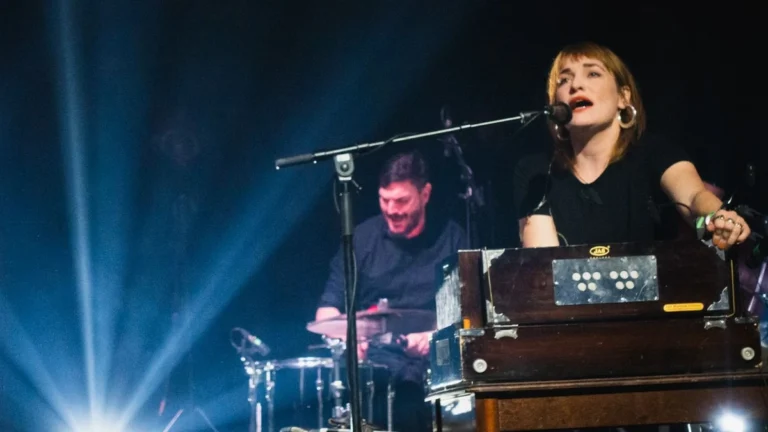
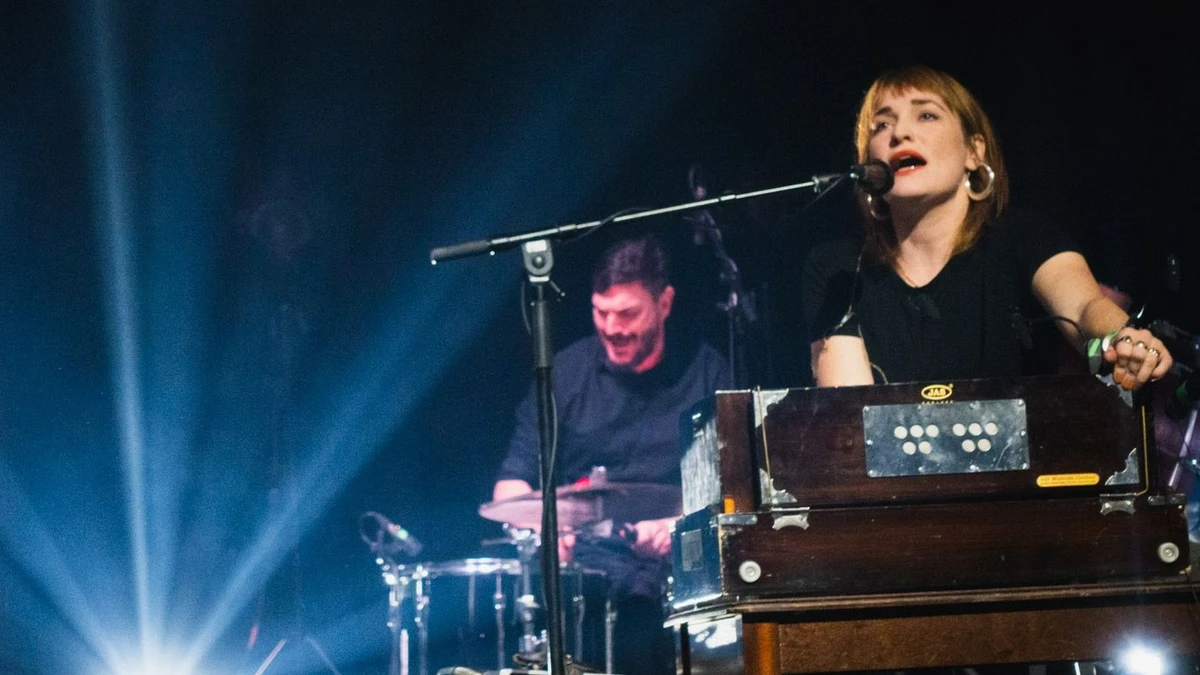
Radie Peat performing with Lankum at the Roundhouse, London, in December 2023.
Radie Peat performing with Lankum at the Roundhouse, London, in December 2023.
The most important recording decision on Radie Peat’s first solo album was made long before a microphone was set up. In her twenties, the Lankum singer watched a documentary about Mike Oldfield making Tubular Bells, and a way of working stayed with her. “The idea just stuck that I would like to try to record like that, where you write and play all the intersecting parts,” she said, as quoted by NME.
She describes that idea as the seed of No Human Tongue Can Tell, the debut solo album Radie Peat releases on November 13 through Rough Trade Records. It is a collection of nine folk songs, and it arrives after two singles that show what the method sounds like: a traditional love song rebuilt around layers of her own contralto, and a traditional song whose lyrics she partly rewrote to channel anger.
A Method Borrowed From Tubular Bells
Oldfield’s Tubular Bells is the famous example of one musician building a record part by part. What Peat took from it was less a sound than a discipline. In the fuller statement released with the album announcement, reported by Uncut, she explained why the approach appealed: “I found the idea of being limited by your own mind and abilities, with all the blind spots and personal preferences, very appealing, and I felt it would make something definitively unique, for better or for worse.”
That is an unusual thing for a member of Lankum to want. Lankum is a four-piece, and its records are ensemble performances. A record made on Oldfield’s terms takes the push and pull of a band away. Every harmony, every instrumental line and every choice about how one part sits against another comes back to a single ear.
She did not make it entirely alone, and she says so plainly. “I’d like to thank John Spud Murphy for making this album with me, without his talent and patience it simply wouldn’t exist,” she said in the statement published by Stereogum. Murphy, a producer, is also her bandmate in ØXN, the Irish quartet with Katie Kim and Eleanor Myler that made the album CYRM.
The idea was a long time coming. “The seed for this album was planted a long time ago,” Peat said. “It’s been ticking along in the background of my head for probably 15 years or so.”
Nine Songs of Struggle, Endurance and Love
Peat says the songs assembled themselves before the theme did. “The collection of folk songs on the album came together easily, and it’s only now I see a thematic link between them,” she said. “They are largely songs of female struggle, suffering, strength and endurance. But there are many about love as well, with all the complications that brings.”
The tracklist, as listed on the album’s Bandcamp page, runs:
- “Hares on the Mountain”
- “The Moon and Stars”
- “Willow Garden”
- “Luisne”
- “Same Old Man”
- “Dark Horse on the Wind”
- “Still I Love Him”
- “Bonnie Boy”
- “Cailín Deas”
She frames the job of singing them as a kind of inheritance, describing the album as “communicating hundreds of years of other people’s experiences, that have been absorbed into the songs from generations and generations before you”. That is the traditional singer’s role, carrying other people’s stories forward, applied to a record built around her own arrangements. “I’ve put a lot of myself in this album and I hope it lands where I was aiming for,” she added.
How Still I Love Him Was Built Around Her Voice
The first single, released in July, showed the method in practice. “Still I Love Him” reached Peat through her friend John Francis Flynn, who found this version of the song in the Irish Traditional Music Archive, wrote a new melody for it and passed it on with a view to foregrounding its female narrator, KLOF Mag reported. Peat folded that melody into her own layered vocal arrangement, building and harmonising her voice for atmosphere.
Her reasons were about control rather than display. “I like indirect,” she said. “I don’t like being too explicit and I wanted the freedom to make decisions around my voice without having to explain myself.” She described what she was after as “creating emotional connection”, adding: “I’m trying to capture the elation and devastation that can accompany obsessive love.”
The arrangement follows the story. Peat set a difficult partner’s escalating behaviour to “minor chords and sombre tones”, then let the chorus swell, “brimming and gushing with romance”, carried by the vocals and the strings. Stereogum heard a “slow and spare” arrangement, over which Peat sings about torturing herself for love. For a recording built from layered vocals, that restraint is the point: the extra parts are there to hold one voice up, not to crowd it.
The Moon and Stars Rewrites a Traditional Lyric
The second single moved somewhere darker. On “The Moon and Stars”, released with the album announcement on September 15, Peat rewrote parts of the traditional lyrics to channel anger, NME reported. One of her new lines runs: “I wish I’d never seen your face or heard your lying tongue.”
“There are coded references to unwanted pregnancies and abortions within the song,” she said, “as well as references to rue, a herb which was used to cause miscarriage.” She wanted, she explained, “to represent these experiences from the woman’s perspective”.
The song also draws on Irish theatre. “When I wrote the lines that refer to screeching and roaring, I was recalling the final scene of John B. Keane’s 1959 play, Sive,” Peat said. In that play, a young woman drowns herself in a bog hole rather than accept an arranged marriage, as KLOF Mag notes, and Peat folds that despair into her own chorus: “Never… if the sun, moon and stars rained down out of the heavens and split the ground under my feet… never!”
Stereogum called the track “haunting from the start”, building into “a riveting, electronic-speckled finale”, and its video was directed by Peter Eason Daniels. The herb in the lyric has a second echo in Peat’s own history: KLOF Mag recalls that she was once a member of a short-lived Irish folk trio called Rue, with Cormac Mac Diarmada of Lankum and Brian Flanagan, which released a cover of “Katie Cruel”.
The Influences Behind the Record
Peat named her touchstones directly. In the album statement published by Stereogum, she listed the artists who most influenced the record musically: Shirley and Dolly Collins, Enya, Lal Waterson, Katie Kim, Jackson C. Frank, Karen Dalton, Nellie Weldon and Liam Weldon.
Read as a list of recordings, it explains a lot about the method. Shirley and Dolly Collins and Lal Waterson are figures of the English folk revival. Enya’s records are known for vocals stacked in many layers, which is close to what Peat describes doing with “Still I Love Him”. Karen Dalton and Jackson C. Frank were American folk singers. Katie Kim is her bandmate in ØXN, which keeps the list close to home as well as reaching back decades.
The Weldon connection runs straight into the tracklist. Track six, “Dark Horse on the Wind”, shares its title with a song the Dublin singer and songwriter Liam Weldon made up in 1966, when the official celebrations of the Easter Rising’s 50th anniversary left him feeling bitter, according to the sleeve notes reproduced by theBalladeers. The song later gave its name to his 1976 album.
From Union Chapel to the Barbican
Radie Peat takes the songs on the road either side of the release. According to NME and KLOF Mag, the dates are:
- November 3: Union Chapel, London (sold out).
- November 20: Vicar Street, Dublin.
- January 31, 2027: Paradiso, Amsterdam.
- February 1, 2027: La Trabendo, Paris.
- May 19, 2027: The Barbican, London.
The Union Chapel show falls ten days before release day, so for that London audience the live performance comes first. The Paris and Barbican dates were added with the album announcement, after the Union Chapel show sold out, and tickets for both went on sale on September 18, KLOF Mag reported. Moving from a chapel in Islington to the Barbican within six months is a clear sign of how much interest the solo project has drawn.
The live shows raise a practical question that the record answers in the studio. An album built by one person playing all the intersecting parts has to be translated for a stage, where those parts must be performed at once. How Peat solves that in a room like Union Chapel is the thing to listen for.
What Lankum Built, and Where This Record Fits
Peat is best known as one of the four members of Lankum, whose fourth studio album, False Lankum, was released in 2023 and was nominated for the Mercury Prize and the Ivor Novello Awards, NME noted. The band’s music has also reached new audiences on screen: “Katie Cruel” and “The Granite Gaze” appear in Netflix’s House of Guinness, and “Hunting the Wren” soundtracks the final scene of the Peaky Blinders film The Immortal Man. Last year, Lankum also covered The Specials’ “Ghost Town” for Oona Doherty’s dance show Specky Clark.
Against that backdrop, No Human Tongue Can Tell is a deliberate step away from the ensemble. Where Lankum’s records are made by a four-piece, this album tests what one singer can build from her own parts, with a producer she trusts beside her. Albums organised around a single governing idea have been a thread on this site lately; acousticmusic.news recently looked at how Max Richter turned ocean waves and gunfire into an album.
The question for November 13 is how the layers sit. On the evidence of the two singles, the answer is with restraint: harmonies that support a contralto rather than bury it, strings that arrive when the story needs them, and electronics saved for a finale. Radie Peat waited around 15 years to make a record this way, and the singles suggest the wait was well spent.
About The Author