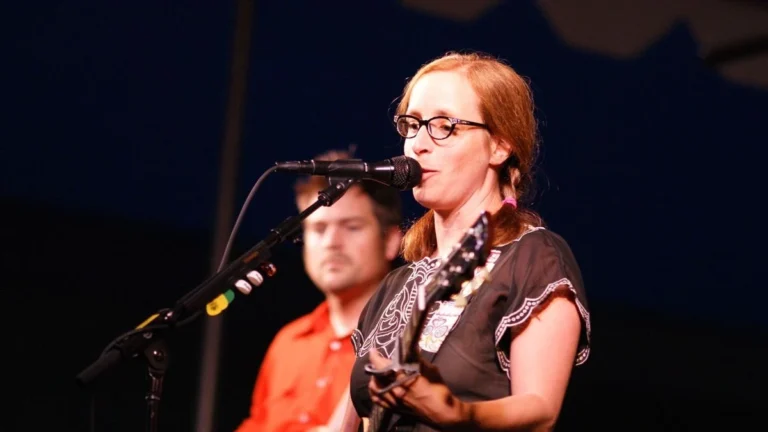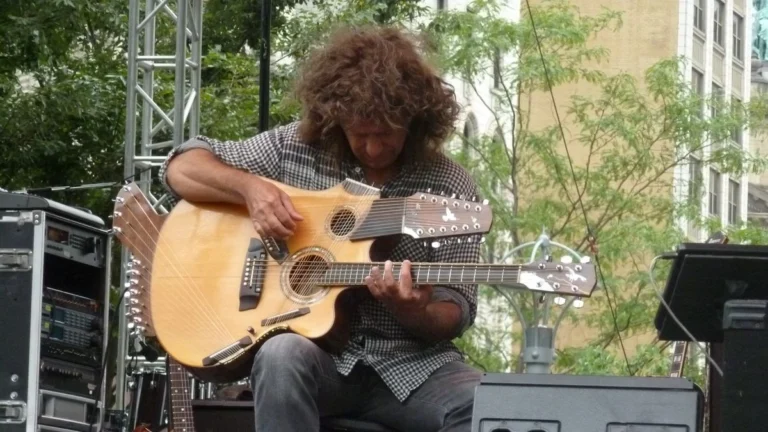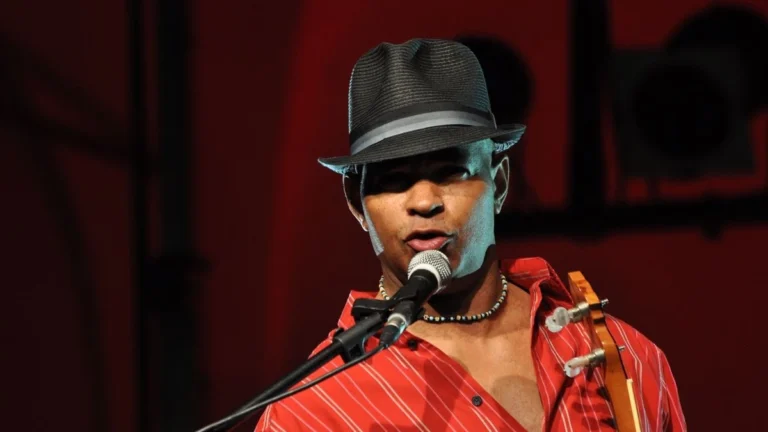

Richard Thompson performing.
Richard Thompson performing.
Richard Thompson does not assemble an album by writing twelve songs for it. He writes, accumulates, and then looks for family resemblance. “You look over the body of songs you’ve written and ask yourself, Which ones are kindred spirits?”
The twelve that turned out to be related make up Hippies, Thugs and Heroes, his twentieth studio album, out on 16 October through New West Records. It is his first since Ship to Shore in 2024.
Kindred Spirits as a Method
He extends the metaphor without embarrassment. “You look for commonality among the songs, and it’s also a joy when you realize that certain songs seem to be brothers and sisters,” he told Glide Magazine.
What the twelve have in common is people. The album is a set of character studies — old friends, false gurus, musicians he admired, earlier versions of himself — some drawn from life and some invented, with the line between them left deliberately unmarked.
That is a different way of making a record from the one the industry assumes. A writer who works to a deadline produces an album of songs written in the same six months; a writer who selects for kinship can put a song from years ago next to one finished last month, and the connection is thematic rather than chronological.
A London Song With Four People In It
“Cocaine Walking, Booze Talking” went out first, and it is the clearest demonstration of the method. KLOF Mag counts the cast: a carousel queen, a soldier quoting Shakespeare, a King’s Road hippie and a Sauchiehall thug.
Four characters in one song is a lot, and the geography is doing work too — King’s Road is Chelsea, Sauchiehall Street is Glasgow. A song that puts them in the same verse is describing a particular kind of London where everyone has arrived from somewhere else.
The arrangement matches the subject. The instrumentation struts and frays before splintering into a psychedelic guitar solo, which is a fair description of most of Thompson’s best work and the reason he has never been comfortably contained by the word folk.
Two to Four Takes
The record was cut at Hobosound Studio in Weehawken, New Jersey, produced by Thompson with James Frazee. The rule in the room was speed: two to four takes per song, no more, to keep the urgency of a first attempt.
That is a discipline rather than a shortcut. A band that knows it has four takes plays differently from one that knows it has forty, and the songs on a record made this way carry the small imperfections that a longer session would have polished out.
The band is a settled one — Taras Prodaniuk on bass, Michael Jerome on drums, David Mansfield on guitar and fiddle, with Zara Phillips singing behind Thompson. Mansfield’s fiddle is the instrument that keeps the record inside the folk tradition even when the guitar solo is heading somewhere else entirely.
A limit on takes also changes what gets written. A songwriter who knows the band will not spend a day on an arrangement builds the arrangement into the song, which is why records made this way tend to have fewer studio ideas and more musical ones. The parts have to work the first time somebody plays them.
It is the same argument acoustic music has been making for a century. A room, a handful of players and a short window produce a document of a performance rather than a construction, and a listener can hear the difference even when they cannot name it.
The Basement Demos
What changed this time was the preparation. “It’s so much fun to mess around at home and disappear down in the basement for hours at a time,” Thompson said, and the result was that he arrived with more finished ideas than usual.
“I was able to present more complete demos to the band,” he said. “You could say there’s much more of my identity being transferred to the final product.” For a songwriter of his standing that is a meaningful admission — that the previous records were shaped partly by what the room decided.
He has not become a dictator about it. “I’m never strict about what I want to hear on a record,” he told Folking. “I’m always interested to see what they come up with.” The demos set the direction; the band still fills it in.
Twelve Titles, No Padding
The sequence runs “Sorcerer’s Apprentice”, “Cocaine Walking, Booze Talking”, “Pauper’s Grave”, “Unsung Hero”, “Make Believe You Don’t Know Me”, “She Burns It All”, “Everybody’s Stealing”, “The Soul In Me”, “Pipe Dreams”, “The Big Smoke”, “Stringer” and “Siren”.
Read as a list, the titles map the album’s territory precisely: a magician’s assistant, a beggar’s burial, an unnamed hero, a thief, a London nickname, a myth. These are songs about types of person, which is what a character study is.
“The Big Smoke” and “Pauper’s Grave” sit at either end of the same city. One is the name London gives itself; the other is where the city puts the people it does not count. Placing both on a record called Hippies, Thugs and Heroes makes the title less a list of three types than a claim that they are frequently the same person at different points.
“Unsung Hero” is the one that gives the game away. An album of character studies that includes a song about somebody nobody sang about is a songwriter explaining what the form is for — the character study exists precisely to record the people the histories leave out.
It is also a very British set of references, made in New Jersey. Thompson has spent much of his career writing about England from outside it, which is possibly why the England in his songs is so much more specific than the one written from inside.
Festivals in August, America in November
The summer was a folk-circuit run: Cambridge Folk Festival on 2 August, Fairport Cropredy Convention on the 14th, St Georges Church Hall in Beckenham on the 21st, FolkEast at Beccles on the 22nd and Beautiful Days at Ottery St Mary on the 23rd.
September takes in Buxton Opera House, Lighthouse Poole, the Subscription Rooms in Stroud, Bromyard Folk Festival and the Wiltshire Music Centre at Bradford-on-Avon. November brings two American dates: Elkton Music Hall in Maryland on the 20th, and the Outpost in the Burbs benefit for Toni’s Kitchen in Montclair, New Jersey, on the 21st.
Playing Cropredy — the festival Fairport Convention run, the band he joined as a teenager — the same summer he announces a twentieth album is a neat piece of symmetry, and a reminder that the British folk revival he came out of is now old enough to have festivals named after its own survivors. He is unsentimental about why he keeps going: “if I don’t write, if I don’t perform, I get frustrated and I feel like I’m not being the human being I should be.”
The plainest statement he has made about the future is also the shortest. “I’m not intending to hang up my plectrum anytime soon.” It is the same instinct that has Bill Callahan chasing the mistakes on a record — a working songwriter’s preference for the take that is alive over the one that is correct.
About The Author