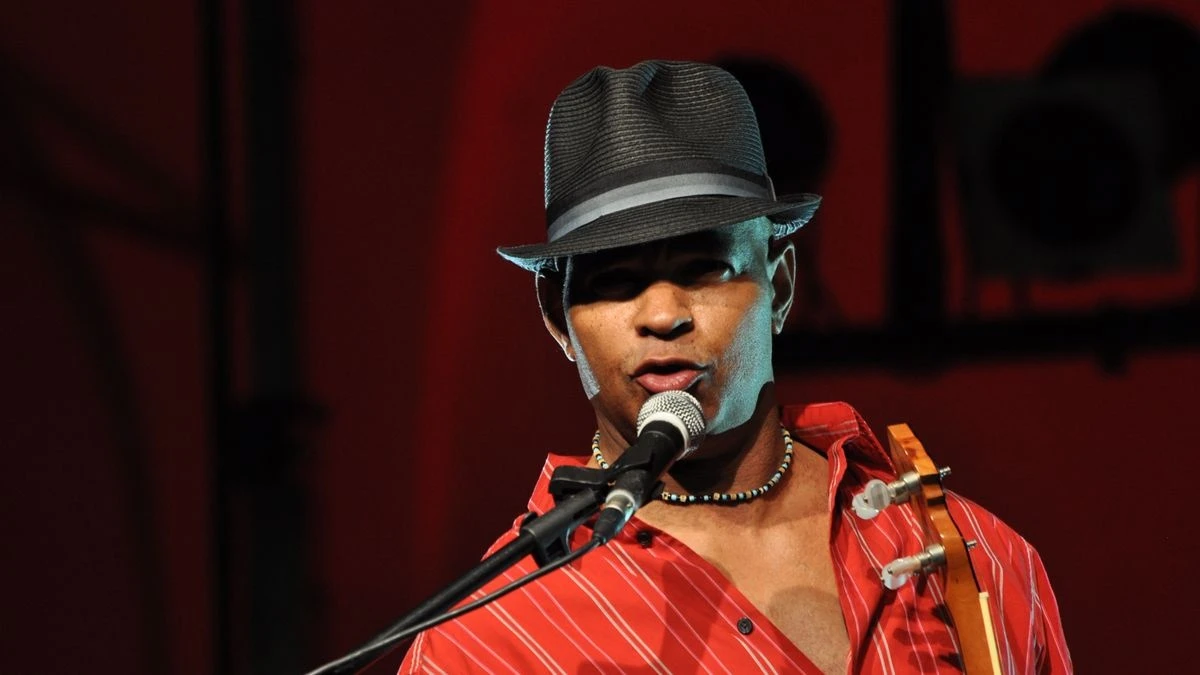
Guy Davis at the Piacenza Blues Festival.
Guy Davis at the Piacenza Blues Festival.
Guy Davis recorded his three songs in New York. Corey Harris recorded his in Virginia. Alvin Youngblood Hart recorded his in Mississippi. The nine tracks became one album, and none of the three men was in a room with the others.
Fight On! True Blues Vol. 2 came out on 17 April through Yellow Dog Records, and it is the sequel to a project the three began in 2013 — nearly thirty years after they first met.
Nine Songs, Three Rooms
The Blues Magazine lists the running order: “We Are Almost Down To The Shore (Fight On)”, “Screamin’ And Hollerin’ The Blues”, “See Me When You Can”, “What’s That I Smell”, “If The Blues Was Money”, “Deep Sea Diver”, “I Belong To The Band”, “Highway 61” and “Everything I Got Is Done In Pawn”.
Three each is a strict division, and the sequencing interleaves them rather than grouping by artist. A listener moving through the album passes from Virginia to Mississippi to New York and back without being told, which is a fair description of how this music travelled in the first place.
The covers form a syllabus. Jimmy Strother’s “Fight On” comes from the Virginia songster tradition; “Screamin’ and Hollerin’ the Blues” is Charley Patton; “I Belong to the Band” is Rev. Gary Davis; “Highway 61” is Fred McDowell; and the closer reworks Elizabeth Cotten’s “Shake Sugaree”.
Recording apart is now unremarkable, and on a record this concerned with tradition it is worth sitting with the irony. Three men who play a music transmitted face to face, on porches and at festivals, made this album by post. What holds it together is not a room but thirty years of knowing what the others would do.
Thirty Years Since a Photograph
Hart’s account of the origin is the best thing in the album’s press. “I have a photograph somewhere of Corey, Guy and myself at the Chicago Blues Festival, 1996,” he told Rock and Blues Muse.
“A time when we were being touted by the ‘Blues Establishment’ as ‘The New Saviors Of The Blues.’ So whatever man, it was destiny that we’d end up doing something like True Blues.”
The “so whatever man” is doing a lot of work. Three young Black acoustic blues players in 1996 were handed a role by an industry that needed one filled, and three decades later they are still playing the music — which is a quieter and more convincing answer to the label than any refusal would have been.
The 2013 record earned its reception on the same premise, and the thirteen-year gap between volumes tells you what kind of project this is. Nobody is running a schedule. It happens when three touring musicians find the same window, which at this point in a career is rarer than it sounds.
The Blindfold Test
The album’s central claim is that the new songs and the old ones are not distinguishable in kind. Jim Hynes made the point plainly in his review: “The original songs are in the same spirit. In a blindfold test, most would think the originals are older.”
That is meant as praise and it is also a technical observation. Harris’s “What’s That I Smell”, Hart’s “If the Blues Was Money” and Davis’s “See Me When You Can” and “Deep Sea Diver” are built with the same materials as the covers — the same tunings, the same forms, the same relationship between a voice and a guitar.
Davis states the position outright: “To us, there is not so much difference between our arrangements of blues classics and our newly created work. It’s all connected to the ancestral spirit.”
Songsters, Not Only Bluesmen
The choice of sources is where the record earns its place outside a purely blues conversation. Jimmy Strother was a Virginia songster; Elizabeth Cotten’s “Shake Sugaree” belongs as much to the folk revival as to the blues; Rev. Gary Davis was a gospel and ragtime guitarist as much as a bluesman.
The songster repertoire predates the commercial category of blues entirely. It held ballads, dance tunes, spirituals and reels alongside blues, and the separation into marketable genres happened at the record companies rather than on the porches.
Reassembling that range on one album is a corrective, and it puts this record next to Eric Bibb’s habit of moving between blues, folk and soul without settling — musicians treating the genre boundary as an accident of commerce rather than a fact about the music.
There is a practical dimension too. The country blues was never written down; it was learned by ear, from records and from people. A working musician who can play a Patton piece correctly is carrying information that exists nowhere else in a reproducible form, and every one of these performances is a copy being made.
A Fight, Named as Such
Harris is the most explicit about what the title means. “The thematic tie of the record lies in the fact that we are three African American bluesmen who are fighting to maintain our cultural legacy and heritage,” he said. “Each of these nine tracks represents a contemporary image of traditional Black lifeways.”
Davis frames the same thing in terms of survival. “The fight we are waging is to keep this precious music form alive.” He has also spoken about the ordinary cost of that work — “the difficulty of being on the road and being where I can help out my family”.
Those two sentences together describe the actual economics. Keeping an acoustic tradition alive is not an abstraction; it is a matter of individual musicians choosing to spend their lives touring a music that pays less than the alternatives.
Elizabeth Cotten is the pointed inclusion. She was a left-handed guitarist who played a right-handed instrument upside down, worked as a domestic servant for most of her life, and was recorded only in old age. Reworking her song as “Everything I Got Is Done In Pawn” pulls a woman into a record otherwise made by three men calling themselves bluesmen.
Smaller Stages and Tents
Hynes ends his review with the sharpest observation on the record’s context. These three, he writes, are “often relegated to smaller stages and tents at festivals” — and are nonetheless “the true torchbearers of the blues”.
Yellow Dog, distributed by MVD, is an independent, which is the only kind of label that releases a record like this. A major would want a name guest and a radio edit; a small label wants nine songs and a release date.
That is the working reality for acoustic blues in 2026. The main stages go to bands with amplifiers, and the players holding the oldest part of the repertoire perform in the afternoon, in a tent, to a few hundred people.
The Blues Magazine’s summary is the right note to finish on: “This is not a museum piece. It is a living conversation between past and present.” An album recorded in three separate states by three men who met at a festival thirty years ago is exactly that — a conversation that has been running long enough to have its own history.
Whether Volume 3 arrives is anybody’s guess. The gap between the first and second was thirteen years, which for three men who have already been playing together for three decades is not a schedule so much as a hope.
About The Author