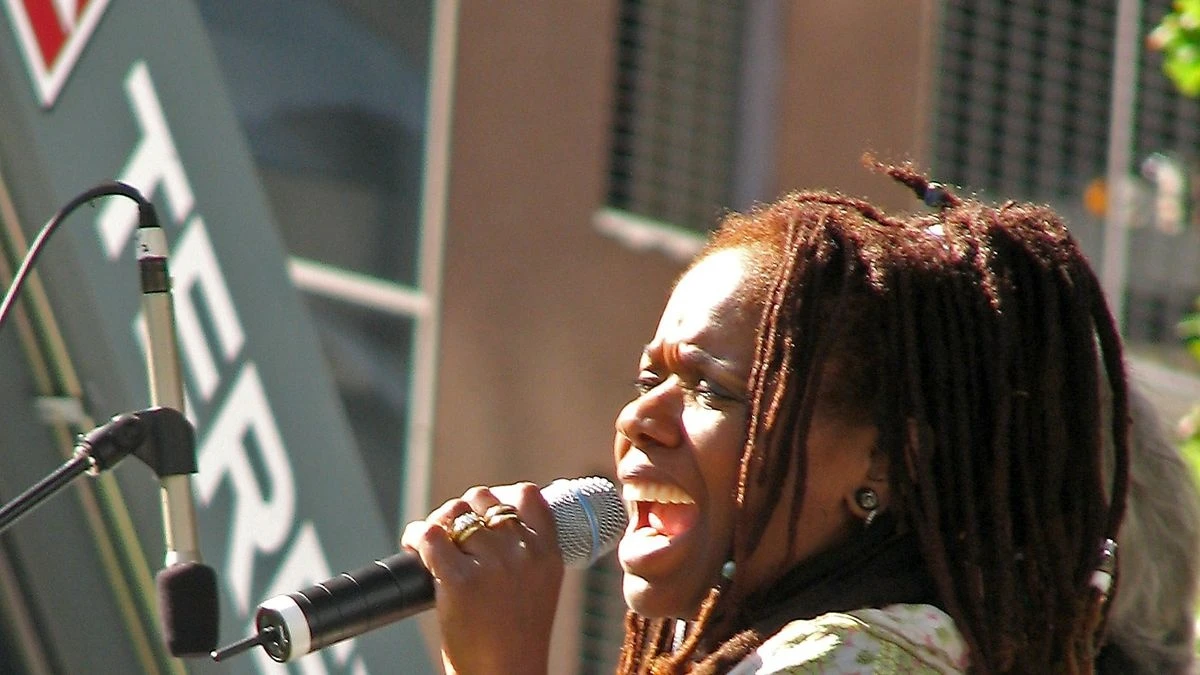
Catherine Russell performing at the Detroit Jazz Festival.
Catherine Russell performing at the Detroit Jazz Festival.
To assemble the programme on her first live album, Catherine Russell went looking through 78rpm shellac records and short films made for coin-operated jukeboxes eighty years ago. What she found is now on a record made at Jazz at Lincoln Center.
Catherine Russell – Live at Jazz at Lincoln Center came out on 24 April through Dot Time Records: eleven songs, captured at the Appel Room during the 2023-24 season, and the first live album of a long career.
Eleven Songs Off Shellac
Dot Time lists the sources, and the list is the point: Hot Lips Page, Tiny Grimes, the Jeter-Pillars Orchestra, Blanche Calloway, Cab Calloway, Helen Humes, Eddie Barefield and Luis Russell.
Most of that material never entered the standards repertoire. It was recorded, pressed, sold in small numbers and left on shellac, and the reason it survives at all is that collectors kept the discs and, in some cases, the soundies — short musical films made for visual jukeboxes in the 1930s and 1940s.
The sequence runs “Now You’re Talkin’ My Language”, “Never Too Old To Swing”, “I Just Refuse To Sing The Blues”, “I Like Pie, I Like Cake”, “You Ain’t Livin’ Right”, “Long About Midnight”, “Keep Your Mind On Me”, “Old Man River”, “If It Ain’t One Thing It’s Another”, “You Can’t Pull The Wool Over My Eyes” and “Everybody Loves My Baby”.
Those titles do a lot of work. A programme that can hold “I Like Pie, I Like Cake” and “Old Man River” in the same set is describing an era in which novelty songs and serious ones sat on the same bill without anyone finding it strange.
The soundies matter as a source in a way that is easy to underrate. They were made for coin-operated film jukeboxes, and because they captured performances rather than compositions, they preserve arrangements, tempos and stage business that no sheet music or studio disc recorded. For a singer reconstructing this repertoire, a soundie is closer to a rehearsal tape than to a document.
A Tap Dancer in the Rhythm Section
Michela Marino Lerman is credited on tracks two, four, nine and eleven — as a tap dancer, on an audio recording. Russell calls her “my special guest, the incredible tap dancer”.
That credit is more literal than it looks. Tap is a percussion instrument, and in the period this music comes from a dancer was frequently part of the rhythm section rather than a visual addition to it. On a live album the feet are simply another voice in the mix.
The band around her is a working swing unit: Matt Munisteri on guitar, Ben Paterson on piano, Russell Hall on bass, Domo Branch on drums, with Jon-Erik Kellso on trumpet, John Allred on trombone and Evan Arntzen on tenor and clarinet. Mark Lopeman wrote the horn arrangements and adaptations.
The horn section is the other period detail. Three horns — trumpet, trombone, and a reed doubling tenor and clarinet — is the small-band configuration that swing worked with once the big bands became too expensive, and it is why this music can be played at all in a room of this size in 2026.
Her Father Is on the Setlist
One of the artists whose material Russell recovered is Luis Russell — a pianist, bandleader and composer, and her father. Her mother was Carline Ray, a vocalist, guitarist and bassist.
That changes what the archival work means. A singer digging through 78s for forgotten swing material is doing scholarship; a singer doing it partly to find her own father’s records is doing something closer to genealogy, and the two are not separable on this album.
Her label’s announcement frames the programme as an honouring of The Hot Club of New York, with arrangements evoking Harlem nightlife, territory bands, New Orleans jazz and the swing era. Those are four distinct scenes, and a family that spanned them is why one singer can hold all four.
The Room With Central Park in It
The Appel Room looks out over Central Park behind the stage, and Russell is not blasé about it. “Performing at the Appel Room, with New York City’s Central Park as a scenic backdrop, was truly an honor,” she said.
It is also an unusually good room to record in. A hall built for jazz with a live audience gives a swing band the thing a studio cannot — a group playing to people, at tempo, with a dancer on stage and no option to fix it later.
An annual residency at the same club is its own kind of archive, too — an audience that returns every February and a band that knows the material well enough to take it somewhere new each year.
The album was previewed during her annual five-night run at Birdland from 10 to 14 February, with the 11th billed as the official pre-release show. BroadwayWorld reported the run.
It also raises the stakes on interpretation. Singing an obscure Helen Humes side is a free act; singing something your father recorded means every choice is measured against a version you grew up with. The safer route would have been to leave that material off, and she did not.
Two Hundred Albums, Three Nominations
Russell has appeared on more than two hundred records and worked with David Bowie, Steely Dan, Paul Simon and Wynton Marsalis — a CV that spans rock, pop and the jazz establishment without belonging exclusively to any of them.
Her own albums have taken three Grammy nominations: Harlem On My Mind in 2016, Alone Together in 2019 and My Ideal in 2024. That is a steady rate of recognition for a singer working almost entirely in recovered repertoire.
The blues in her programme is not a stylistic gesture either. “I Just Refuse To Sing The Blues” is a joke on a record that spends much of its time doing precisely that, and the swing and blues material she has chosen come from a period before the two were sold as separate products.
Why the First Live Album Comes Now
A singer this deep into a career releasing a first concert recording is worth pausing on. Studio albums let a performer assemble an ideal; a live album commits to one night, one tempo and whatever the room did.
For this repertoire it is arguably the more honest format. These songs were written for rooms with dancers in them, recorded quickly onto shellac, and never intended to be perfected. Capturing them in front of an audience with a tap dancer on stage is closer to the original condition than any studio session would be.
There is a preservation argument in it as well, and it is not a sentimental one. Repertoire that nobody performs eventually stops being playable — the arrangements are lost, the idiom is forgotten, and what remains is a scratchy disc nobody can reproduce. Putting eleven of these songs in front of an audience with a live band is the only method that actually works.
It is a different kind of assembly from Lakecia Benjamin’s studio record built around nine guests, and the two describe the same instinct from opposite ends — that jazz is a thing people do together in a room, and a recording is a report on that rather than a replacement for it.
About The Author