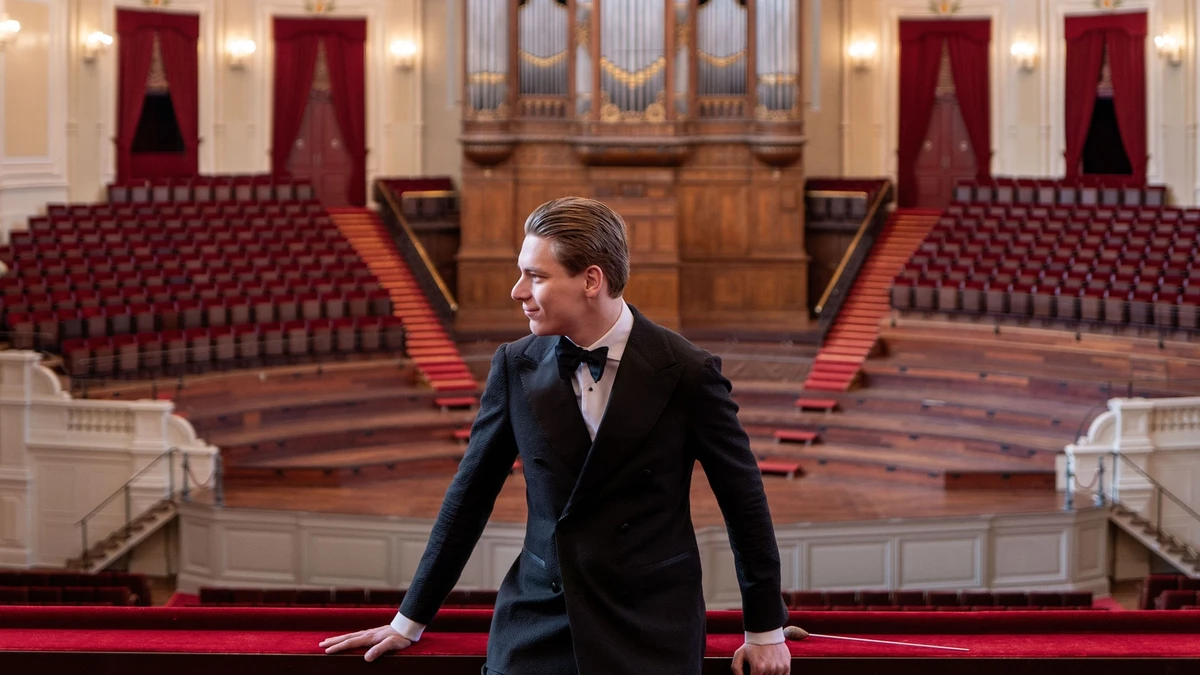
Klaus Mäkelä at the Concertgebouw in Amsterdam.
Klaus Mäkelä at the Concertgebouw in Amsterdam.
Klaus Mäkelä will become music director of the Chicago Symphony Orchestra and chief conductor of the Royal Concertgebouw Orchestra in the same season. Neither job begins until 2027. He has spent the interval doing both anyway.
In Chicago his title is Zell Music Director Designate; in Amsterdam, Conductor Designate. He is also still chief conductor in Oslo and music director in Paris.
Four Residencies Before the Contract
The Chicago Symphony scheduled four Mäkelä residencies across the 2025/26 season, the first in October 2025. The orchestra’s own account frames it as a return after a run of international work, and the list is not modest: the Berlin Philharmonic, the Orchestre de Paris and the Concertgebouw.
The Berlin date was the Easter Festival in Baden-Baden on 19 April 2025, with Richard Strauss’s An Alpine Symphony. That is not a piece handed to a young conductor as a favour; it needs an enormous orchestra and a very clear head about pacing.
A designate period of two years is unusually long, and it exists because both institutions are buying a career rather than a season. The residencies are how an orchestra and a conductor find out whether they can work together before either is contractually stuck with the answer.
He is twenty-eight, and CBS Chicago reported him as the youngest head conductor the orchestra has had since it was founded in 1891. He succeeds Riccardo Muti, music director from 2010 to 2023 and now music director emeritus for life.
His CSO debut came on 18 April 2024 at Symphony Center, repeated across that weekend, with a programme that told the orchestra a good deal about him: the US premiere of Sauli Zinovjev’s “Batteria”, Shostakovich’s First Cello Concerto with Sol Gabetta making her own CSO debut, and Shostakovich’s Tenth Symphony.
A new Finnish work, a concerto with a debuting soloist and one of the most politically loaded symphonies in the repertoire is not a safe first programme. It is a statement about what the next decade in Chicago is likely to contain.
A Symphony of a Thousand
The centrepiece of 2025 was the Mahler Festival in Amsterdam, held for only the third time. Mäkelä conducted the First and the Eighth symphonies with the Concertgebouw Orchestra, leading combined Dutch and French choirs for the Eighth.
The Dutch newspaper Trouw gave it five stars, describing a performance “beautifully supported by the sounds of the great organ and by the Concertgebouw Orchestra, which had this symphony on the lectern for the 32nd time after its premiere under Willem Mengelberg in 1912”.
That sentence contains the whole weight of the job. An orchestra that has played Mahler’s Eighth thirty-two times since 1912 does not need to be taught the piece, and a conductor arriving in front of it has to offer something other than instruction.
Decca released the result. The announcement in November confirmed the Eighth, recorded live at the festival, as a Concertgebouw album under its conductor designate.
Succeeding Muti is its own kind of problem. A music director who held the post for thirteen years and remains emeritus for life leaves an orchestra with settled habits, and the incoming conductor has to decide which of them are the orchestra’s character and which are simply his predecessor’s preferences.
The Chicago Connection Runs Both Ways
The Chicago Symphony was the only North American ensemble to perform at that festival, and Mäkelä attended its concerts — the Sixth Symphony on 15 May and the Seventh on 16 May, both under Jaap van Zweden.
A conductor sitting in the hall listening to his future orchestra play Mahler under somebody else is a peculiar and useful position. He was watching what the ensemble sounds like when he is not responsible for it.
He also met the CSO’s Women’s Board at a pre-concert event during the orchestra’s patron tour in Amsterdam, which is the unglamorous half of a music director’s job and starts long before the title does.
The Mahler Eighth is also a shrewd first major recording with the orchestra. It requires forces so large that it is rarely programmed, which means every performance is an event, and capturing one live rather than assembling it in sessions puts the orchestra’s own sound on record rather than a produced version of it.
Paris, Oslo, and Two Farewells
While all of this was happening he took the Orchestre de Paris to Asia in June 2025, opening at Tokyo’s Suntory Hall with Ravel and Mussorgsky and playing sold-out concerts in Japan, Taiwan and South Korea.
The Concertgebouw’s summer festivals tour followed — Cologne, Berlin, the Salzburg Festival, the BBC Proms at the Royal Albert Hall, and a close at Vienna’s Konzerthaus. Four of the most demanding audiences in Europe inside a few weeks.
He has been chief conductor in Oslo since 2020 and music director in Paris since 2021, and both relationships are winding towards their conclusions as the 2027 posts approach. Managing two departures and two arrivals simultaneously is the actual administrative feat here.
Two farewell seasons and two designate periods running simultaneously is a scheduling problem most conductors never face, and it is the reason the diary looks the way it does. Every orchestra involved wants his best work at the same time, and three of the four know they are losing him.
What Is Already on Record
The Decca catalogue is substantial for a conductor at this stage. With the Orchestre de Paris: Ballets Russes scores by Stravinsky and Debussy, and Berlioz’s Symphonie fantastique paired with Ravel’s La Valse.
With the Oslo Philharmonic: the complete Sibelius symphonies, the Sibelius and Prokofiev first violin concertos with Janine Jansen, and Shostakovich’s Fourth, Fifth and Sixth.
A complete Sibelius cycle is the traditional calling card for a Finnish conductor and also the hardest thing to do without sounding like a national obligation. Recording it early, rather than saving it for a valedictory box, is a confident sequencing decision.
The Sibelius and Prokofiev violin concertos with Janine Jansen point at the other half of the job. A music director spends as much time accompanying soloists as shaping symphonies, and a conductor who can build a concerto around a strong-willed violinist without either flattening her or disappearing is doing the harder of the two tasks.
The Cellist in the Room
Mäkelä also performs as a cellist, which is worth more than a footnote. Conductors who maintain an instrument keep a physical relationship with the sound they are shaping, and it tends to show in how they handle string sections.
It puts him alongside soloists rather than above them — a different posture from the podium-only tradition, and one shared by musicians like Yuja Wang, who has begun leading orchestras from the keyboard rather than only playing in front of them.
His age is the fact everyone reaches for, and it is the least interesting one. What matters is that two institutions with very long memories looked at the same conductor and reached the same conclusion within months of each other, which is not something that happens by accident or by hype.
Whether two of the world’s major orchestras can share one music director is the question the 2027/28 season will answer, and nobody yet knows. What the last two years demonstrate is that the workload does not appear to be the obstacle.
About The Author