
A banjo beside an opera singer, a fiddle in conversation with a cello, one New England player switching between five instruments on nine tunes: the first five nominees for Best Traditional Folk Album in 16 years do not sound like a museum piece. The Recording Academy has brought the Traditional Folk award back for the 69th Grammys, which will be presented in Los Angeles on 7 February 2027, after a proposal from Folk Alliance International.
The category was last presented at the 2011 Grammys, when the Carolina Chocolate Drops won for Genuine Negro Jig, according to the Recording Academy’s guide to this year’s nominees. Its return splits folk in two again, and the first set of nominees shows how wide the traditional side has become.
Why the Grammys Split Folk in Two Again
The change came from the folk community itself. Folk Alliance International announced on 16 June that the Recording Academy had accepted its proposal to reinstate a separate traditional award. The existing Best Folk Album was renamed Best Contemporary Folk Album, and Best Traditional Folk Album was created beside it.
Folk Alliance framed the change as fixing what it called “a significant representation and credibility gap in the genre”. Its announcement went further: “This reinstatement also challenges the long-held stereotype that folk music is exclusively Eurocentric.” The organisation also said it will submit recordings for both folk categories on behalf of members who are not Recording Academy members, so an artist without a label or agency can still be considered.
Traditional folk was one of five new categories for 2027, alongside Best Asian Pop Music Performance, Best R&B Collaboration or Duo/Group Performance, Best Traditional Pop Vocal Performance and Best Latin Song, as American Songwriter reported. “2027 is going to be an amazing year for the Grammy Awards, and one that reflects the extraordinary growth we’re seeing across music,” Recording Academy CEO Harvey Mason Jr. said when the categories were announced.
What Counts as Traditional Folk Now
The definition is broad by design. According to Folk Alliance, the category recognises albums built on folk song structures, harmonic structures and rhythms, played on traditional instruments from traditions around the world, including piano, harmonica, woodwind, strings and percussion. It names song types such as old time, a cappella, work songs, shanties, protest songs, call and response and ballads, and requires music “created in and/or passed through community-rooted tradition distinct from Regional Roots”.
The award goes to the artists, producers, engineers or mixers and songwriters credited with more than half of an album’s playing time. That matters for traditional records, where arrangers and engineers can shape an old tune as much as the performer. The Recording Academy’s own summary puts it in plainer terms: the category honours “music rooted in established song structures and community traditions, from old-time tunes and ballads to work songs, sea shanties and protest songs”.
A Soprano and a Banjo on The Fiddle and the Drum
The most high-profile nominee pairs the soprano Renée Fleming with the banjo player Béla Fleck. The Fiddle and the Drum was recorded in Nashville between 2023 and 2025 with Fleck producing, according to the Recording Academy. It mixes traditional songs including In the Pines and The Cuckoo with Ola Belle Reed’s My Epitaph, Hazel Dickens’ Pretty Bird and a title track by Joni Mitchell.
The guest list is long: Jerry Douglas plays on The Cuckoo, Dolly Parton sings on In the Pines, and Vince Gill, Aoife O’Donovan, Sierra Hull and Sarah Jarosz all appear across the record. The album peaked at No. 2 on Billboard’s Classical Crossover Albums chart. Both artists arrive with Grammy history. Fleming is a five-time winner, most recently for Best Classical Solo Vocal Album at the 2023 Grammys, and Fleck is an 18-time winner across several genres, including Best Folk Album at the 2016 Grammys with Abigail Washburn.
Two Sisters, a Fiddle and a Cello
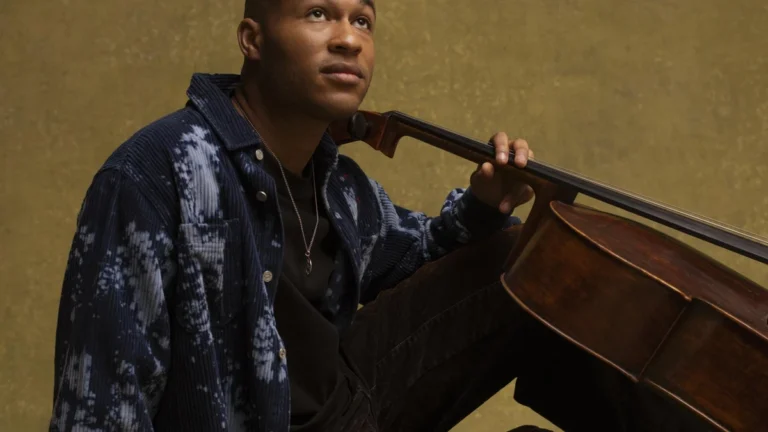
North Node is the second album from the sisters Natalie Haas, on cello, and Brittany Haas, on fiddle, following their 2023 album HAAS. The Recording Academy describes it as blending “Celtic, American and Scandinavian fiddle traditions in a conversation between fiddle and cello”, with Sam Bush and Darol Anger joining on three tracks. It is the first Grammy nomination for both sisters.
The record has been well reviewed. Songlines gave it nine out of ten, with reviewer Doug Deloach calling it “a definitive expression of the genre” and noting that its 13 tracks “range thematically from the playful and ruminative to the inspiring and luminous”. He singled out Swan Carnival for “Natalie’s thumbed pizzicato introduction to a swinging reel crosscut by Brittany’s sharply articulated fiddle”.
Brittany Haas has a second nomination this year, in Best Instrumental Composition, as a co-composer of Punch Brothers’ Found In A Frozen Fog. The Recording Academy describes her as known for her work with Crooked Still and Hawktail and as the newest member of Punch Brothers.
New England’s Fiddle Funnel
The least famous nominee may be the most traditional. E J Ouellette is a Massachusetts multi-instrumentalist with five decades of “playing, teaching and documenting New England, Acadian, Scottish, Irish, Quebec, and Cape Breton music”, according to the Recording Academy. The Fiddle Funnel Sessions, released in July on his own Whole Music Records, runs to nine instrumental tracks, from strathspeys to jigs and waltzes, with Ouellette playing fiddle, mandolin, banjo, viola and guitar.
The title is his name for New England as a cultural meeting point, where “immigrant traditions mixed in mill towns, fishing communities and dance halls”. The Fairport Convention drummer Dave Mattacks plays on the record. It is Ouellette’s first Grammy nomination, and it shows what the new category can do: put a self-released, deeply regional record on the same list as international stars.
Old Friends and a Prolific Newcomer
Tom Paxton and John McCutcheon are nominated for Together Again, their second album as a duo after 2023’s Together. The partnership began in 2021, when the two met weekly over Zoom during pandemic isolation, and the new album includes Ran Away with the Circus, Last Man Sitting and Lay This Old Guitar Down. Paxton, described by the Recording Academy as a central figure of the 1960s folk revival, was nominated in this same category at the 2006 and 2009 Grammys and received the Academy’s Lifetime Achievement Award in 2009. McCutcheon has six previous nominations, all in children’s categories, so this is his first in a folk category.
Jesse Welles is the opposite case: a songwriter who, in the Academy’s words, “built his audience by writing fast and posting often”. Under the Powerlines III collects 61 tracks from the first half of 2025, part of a series that gathers his frequent releases into albums. Volume I was nominated for Best Folk Album at the 2026 Grammys, and this year Welles has five nominations, the most of anyone in the category, including No Kings with Joan Baez in Best American Roots Performance and Masks Off in three Americana and roots categories.
What to Listen For Before 7 February
Taken together, the five albums cover a remarkable range of what traditional music can be in the recording studio: an opera singer reinterpreting Appalachian songs, two sisters writing new tunes in old forms, a regional scholar’s living archive, two veterans trading songs over video calls and a prolific writer who releases new songs almost as fast as he writes them. Few listeners will have heard all five, and that is the strongest argument for the category’s return.
The winner will be named at the ceremony on 7 February 2027, broadcast live on ABC, Disney+ and Hulu from Crypto.com Arena in Los Angeles. Reworking older material is not only a folk habit; we looked at the same instinct in jazz when Joshua Redman played Sonny Rollins in 5/4, 7 and roughly 11. Traditional Folk now has its own place on the biggest stage the industry offers.
About The Author