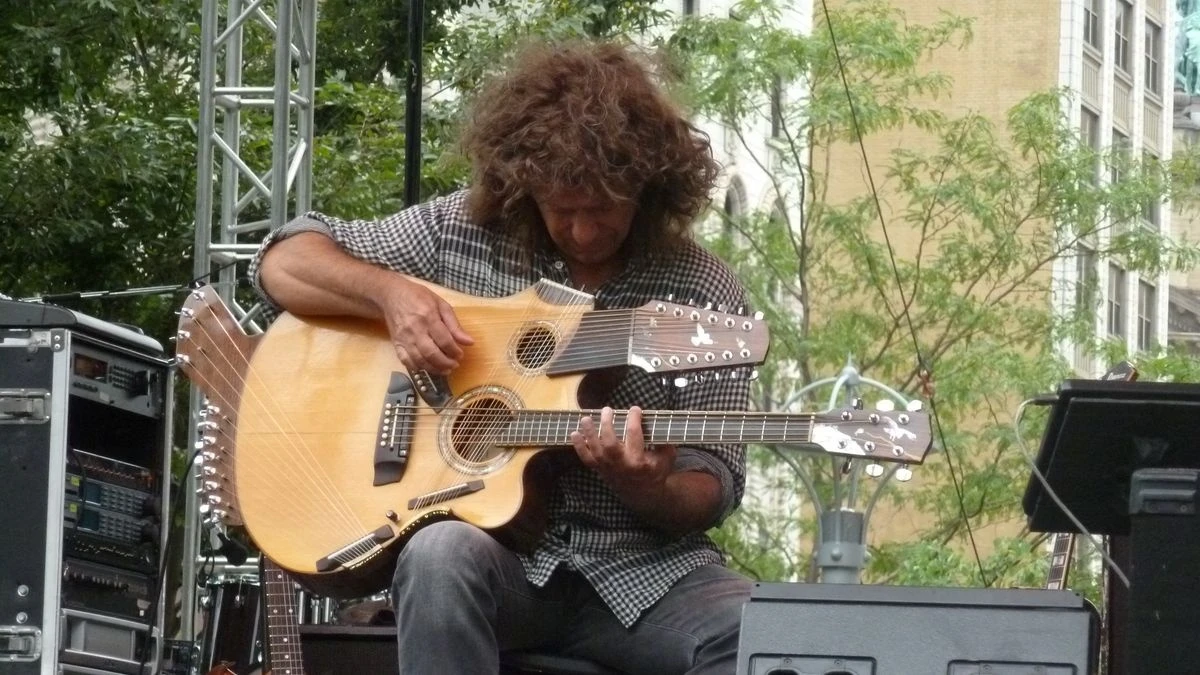
Pat Metheny playing the Pikasso guitar.
Pat Metheny playing the Pikasso guitar.
Pat Metheny has twenty Grammy awards and a catalogue reaching back to the mid-1970s. For his first major studio album in six years he started his own record label.
Side-Eye III+ arrived on 27 February through Uniquity Music, an imprint launched in partnership with Primary Wave. Eight new compositions, recorded at Dreamland Studios in Woodstock.
Why a Musician of His Standing Starts a Label
An artist with Metheny’s catalogue does not lack for label interest. Owning the imprint is therefore a decision about control rather than access — over release timing, over what counts as an album, and over what happens to the recordings in twenty years.
It also fits the project. Side-Eye is, in the announcement’s words, “an ongoing collaboration concept built around spotlighting and performing with the next generation of standout musicians”. A rolling series with a changing cast is easier to run when nobody else has to approve the next instalment.
The plus sign in the title is doing similar work. This is not a new band with a new name every time; it is the same idea, incremented, and the punctuation is the only announcement it needs.
Primary Wave’s involvement is the part worth reading closely. It is a company built on catalogue rather than on new releases, and an artist partnering with it while retaining his own imprint is arranging for the recordings and the ownership to sit in the same place — a very different structure from a conventional album deal.
Eight Songs From Woodstock
Glide Magazine walks through the record. “In On It” opens it, with what Doug Collette describes as “bright fluid guitar abounds, underpinned by limber rhythm work”. “Don’t Look Down”, the first single, evokes the early Pat Metheny Group line-ups.
“Make A New World” runs past ten minutes and, in the review’s phrase, “evinces as much careful arrangement as spirited improvisation” — the balance every long-form jazz composition is trying to strike and most do not. “SE-O” is a streamlined, uptempo number; “Our Old Street” is contemplative, and its “nostalgic overtones are hardly sentimental”.
The personnel is larger than the trio the project is named for. Chris Fishman plays keyboards and Joe Dyson drums, with Daryl Johns on bass, Luis Conte on percussion and James Francies on organ. Steve Rodby, a long-standing Metheny collaborator, is associate producer.
Choosing a residential studio outside a city is a decision about the room rather than the console. A jazz group needs a space where an ensemble can play together and be heard doing it, and on an album with an organ and a choir on it that requirement arrives before any of the arrangements do.
Eight compositions is also a specific quantity. It is short enough to hold a listener across a ten-minute centrepiece and long enough to justify a five-month campaign, and it suggests a writer who stopped when the material stopped rather than when the running time was reached.
A Gospel Choir on a Metheny Record
“Urban And Western” carries organ and a gospel choir, which is not an instrument that appears on jazz-guitar albums by accident. The title names the collision directly, and a choir is the loudest possible way to make it.
That kind of move is easier to justify when the record is being released by the person making it. A choir costs money, adds nothing to a streaming metric and cannot be reproduced live on a fifty-five-date club and theatre tour. It exists because somebody wanted it on the album.
The review’s overall verdict is that none of this reads as strain. Collette hears “vintage Metheny” with “no tangible sense of self-consciousness”, and describes the record as a “deeply personal, readily identifiable work” with “warm, inviting tones — plus an unmistakable, albeit slight, edge”.
Naming the tour after the album and the album after the project also collapses three marketing decisions into one. There is no separate campaign to run, and the audience arriving at the Ryman knows exactly what it is buying a ticket to hear.
Spotlighting the Next Generation
The Side-Eye premise is worth taking seriously rather than treating as a marketing line. Metheny is at the point in a career where the obvious options are a legacy tour or a duo record with a peer, and he has instead built a vehicle for playing with musicians decades younger.
Fishman and Dyson are the current beneficiaries, and the arrangement is not charity in either direction. A young keyboard player gets a global platform; the bandleader gets a rhythm section that has not spent thirty years learning his habits.
It is the opposite instinct to the one behind Bill Frisell’s In My Dreams, which reunited players he has known for forty years — two guitarists of comparable standing solving the same late-career problem in exactly opposite ways.
There is a succession argument in it too, and it is unsentimental. Musicians who pass through a band of this profile tend to lead their own afterwards, and the surest way for a bandleader’s approach to outlive him is to keep handing it to people who will still be working in forty years.
Fifty-Five Nights
JamBase counted the North American run: fifty-five dates between 2 March in Jackson, Mississippi and 9 May in Chandler, Arizona, with Jermaine Paul taking the bass chair on the road.
The venues describe the peculiar position a jazz guitarist of this stature occupies. The Ryman Auditorium in Nashville on 22 March, Orchestra Hall in Chicago on 17 April, Walt Disney Concert Hall in Los Angeles on 4 May — concert halls — alongside two nights at the Dakota in Minneapolis and four at Jazz Alley in Seattle, which are clubs.
Then Europe. The dates run through to late July, taking in the Barbican in London, which makes the whole campaign close to five months of playing behind an eight-song record.
Four consecutive nights at a single club is the detail that separates a jazz tour from a rock one. It assumes an audience that will come more than once, a band that will play differently each night, and a bandleader who regards a residency as a better test than an arena.
Six Years, and What Filled Them
The gap since the last major studio album is the number the coverage keeps returning to, and it is worth putting in context. Metheny has not been quiet — the Side-Eye project itself has run through earlier volumes, and the touring has been continuous.
What the six years mark is the interval since he last sat down and wrote a full record of new compositions for release. On an album of eight originals delivered at this stage of a career, that distinction is the entire story.
The label is the piece that makes the rest repeatable. A six-year gap is survivable once; an artist who intends to keep working at this pace for another decade needs somewhere the next record can go without a negotiation, and Uniquity is that. It also means the Side-Eye numbering can continue indefinitely, with each volume arriving whenever the players and the material line up rather than whenever a contract says so.
Collette’s summary is the one that lands: an artist showing “continuing creative vigor” and “emotional resonance”, balancing past and present momentum. Starting a label to put it out suggests he expects to need somewhere to keep doing it.
About The Author