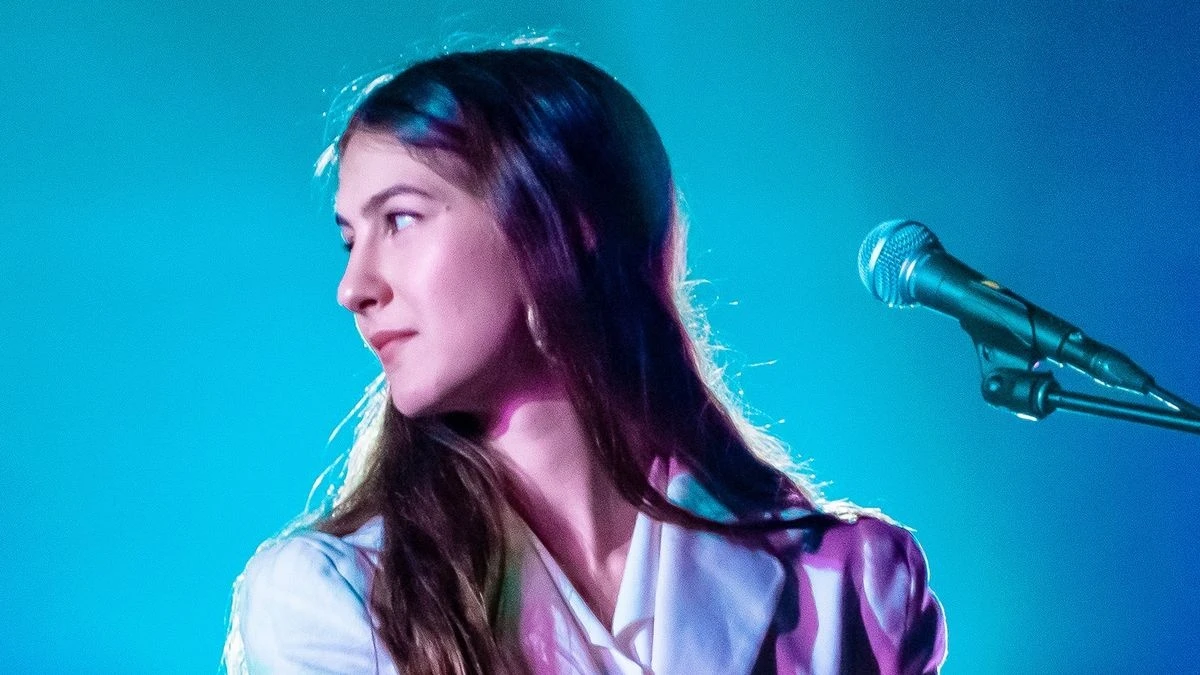
Weyes Blood performing.
Weyes Blood performing.
The room Weyes Blood has been recording in sits underneath Electric Lady Studios in Greenwich Village, and Natalie Mering describes it the way a sailor would. “Like a submarine,” she said. “It’s really close to the underwater river, and I guess Jimi Hendrix built that space there to be close to the flow.”
Whether the geology is exact matters less than the working conditions it produced. “We would get in there, and seven hours would just zip by without a single glance at the sun. We would just be in our bunker, experimenting.”
A Bunker With No Windows
Electric Lady is one of the most storied rooms in American music, and the reason artists still book it is not the equipment. It is a building with a particular relationship to time, and Mering’s account — seven hours vanishing, no daylight, an “amazing, timeless kind of energy” — is the reason people keep going back.
It also explains something about the record’s schedule. A studio where a day disappears without notice is not a place that produces albums quickly, and this one has taken longer than any she has made.
Far Out reported the April update, when Mering posted studio photographs with a caption that has become the album’s unofficial tagline: “IF you’ve been wondering… I HAVE been in the studio. This one’s taking an extra minute to cook because it’s… extra delicious. Hope you’re hungry.”
The choice of room is also a statement about instrumentation. Electric Lady is a live room built for bands, not a laptop suite, and booking months of time there implies players, amplifiers and takes rather than a record assembled in software. For a singer whose last album leaned heavily on orchestration, that is a meaningful signal.
Four Years, and What Changed in Them
And in the Darkness, Hearts Aglow came out in November 2022, which puts the gap at close to four years. That is a long time for an artist working at her level, and she has said what the delay is in service of.
The album is, in her description, “very reflective of the time I’m at in my life, and how much being a woman changes over time”. That is a subject that does not reward being rushed, and it is not the sort of thing a songwriter can write to a deadline set three years earlier.
It is the same calculation José González made across nearly five years before releasing Against the Dying of the Light — an album that arrives when the material does, and a career established enough to absorb the wait.
There is a commercial risk in it too, and she is plainly absorbing it. Four years is long enough for an audience to move on, for a label to lose patience and for the cultural moment a record was conceived inside to close. Artists who take that long usually do so because they have decided the alternative is worse.
A Wordless Dance on Somebody Else’s Synths
What she did release in the interval was a voice on somebody else’s record. Daniel Lopatin, who works as Oneohtrix Point Never, brought her onto the score for Marty Supreme, the Josh Safdie film starring Timothée Chalamet as the table tennis player Marty Mauser.
Mering sings on “Force Of Life”, the track that plays at the end of the film. Stereogum lists her contribution as vocal layers, with Laraaji on percussion, and quotes her characteristically light description of the job: “a little wordless dance on top of Daniel’s synth beds…”
Wordless is the operative term. A singer whose records are built on lyrics and multi-tracked harmony, hired to supply pure vocal texture over synthesizers, is being used as an instrument rather than as a writer — and it is a role her voice suits unusually well.
Twenty-Two Tracks and an Obsession With Buoyancy
Resident Advisor reported the score’s release on 25 December 2025 through A24 Music: twenty-two tracks, Lopatin’s third film with Safdie after Good Time and Uncut Gems.
The press description is a good summary of what Mering was singing over — “neoclassical orchestration, widescreen synth ecstasy and tactile ’80s hardware”. Lopatin’s own account of the score is more specific: “The music of Marty Supreme came from an obsession with coaxing melody out of buoyant sounds.”
Buoyancy is a useful word for the pairing. Mering’s voice has always had a floating quality, sitting on top of an arrangement rather than driving it, and a composer chasing buoyant melody hired exactly the right singer.
The film’s own soundtrack choices are stranger still. Set in 1952, it uses 1980s songs — Alphaville, Peter Gabriel, Tears for Fears — which makes Lopatin’s period-agnostic synth score the connective tissue rather than the anachronism.
Film work also solves a problem for a songwriter mid-album. It keeps the voice in front of an audience without spending any of the material being written, and it puts the singer in somebody else’s process for a few days — which is frequently the fastest way to get unstuck on your own.
Two Ways of Using the Same Voice
The collaboration is not new. Lopatin played on “God Turn Me Into A Flower” from her last album, and the traffic has now run in both directions — his synthesizers under her song, her voice over his score.
That relationship is worth watching for what it might mean for the record still being finished. An artist who has spent four years underground with a producer, and who has just spent a session functioning as pure texture on somebody else’s electronics, has been in two very different rooms recently.
Her records have never been straightforwardly acoustic. The instrument at the centre is her voice, arranged in layers that reviewers have consistently traced back to seventies orchestral pop rather than to any folk tradition, and the guitar has always been one option among several.
That range is what makes the wait defensible. A voice that can carry a lyric on one record and function as pure colour on another is not a limited instrument, and an artist testing both uses inside the same period is unlikely to deliver a repeat of the last album.
Hope You’re Hungry
Nothing about the album has been formally announced — no title, no date, no single. What exists publicly is a set of studio photographs, a caption about cooking, a description of a windowless room and a sentence about what it means to be a woman at a particular age.
That is unusually little information for an artist of her standing this far into a record, and the restraint is consistent with the rest of it. A four-year gap and a submarine are not the components of a marketing plan.
It is also, in its way, a very old-fashioned position. Announce nothing, disappear into a basement, and let the record be the announcement. That is how albums worked before release schedules were built around streaming windows, and it requires an artist confident that an audience will still be there.
The last line of the April post is the only commitment she has made, and it is not about a date. “Hope you’re hungry.” On the evidence of the records that came before it, the appetite is not the problem.
About The Author