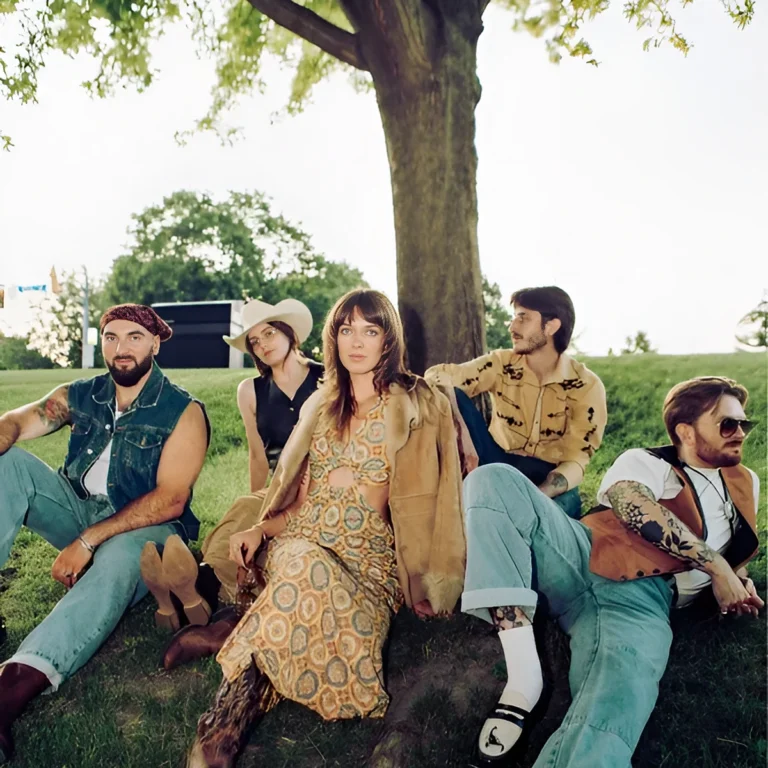

Sam Beam called the new Iron and Wine album Hen’s Teeth because he did not expect it to exist.
The record was announced on 7 January and released the following month through Sub Pop, ten songs recorded in Los Angeles, following 2024’s Grammy-nominated Light Verse.
A Title About Impossibility
Beam’s explanation is short and unusually candid. “To me it suggests the impossible,” he said. “Hen’s teeth do not exist. And that’s what this record felt like: A gift that shouldn’t be there but it is. An impossible thing but it’s real.”
That is not the language of a writer describing a plan. It describes an album that arrived rather than one that was scheduled, which for an artist thirty years into a career is worth noticing.
The circumstances support it. Light Verse came out in 2024 and earned a Grammy nomination, and the conventional next step after that is a long gap while the follow-up is carefully considered.
Instead the material accumulated. Beam spent 2025 releasing collaborative work — the single “Robin’s Egg” with I’m With Her, and a covers EP, Making Good Time, with Band of Horses’ Ben Bridwell.
An album that materialised out of that activity is a different object from one written to a deadline, and “a gift that shouldn’t be there” is a reasonable way to describe finding out you have one.
I’m With Her Appear Twice
The clearest thread from the collaborative year into the album is I’m With Her, the trio who feature on two of its ten tracks: “Robin’s Egg”, the previously released single, and “Wait Up”.
Carrying a single from the year before onto the record is a small structural decision with a real effect. It means the album absorbs work that already existed rather than starting from nothing, which is exactly how a record can appear without a writing campaign preceding it.
Two features from the same act on a ten-track album is also a lot. It suggests the relationship was generative rather than transactional — a collaboration that produced more than one song because the people involved kept working.
The rest of the personnel are session players and long-standing collaborators: David Garza, Sebastian Steinberg, Tyler Chester, Griffin Goldsmith, Beth Goodfellow, Kyle Crane and Paul Cartwright.
Two drummers on the credit list, in Goldsmith and Crane, alongside Goodfellow, points to a record assembled across sessions rather than cut by one band in one run.
The Ben Bridwell EP is worth mentioning for the same reason. Making Good Time was a covers record, and covers are what a songwriter makes when the impulse to record is stronger than the impulse to write — which is a plausible description of the year that produced this album.
A songwriter working continuously in collaboration is also being kept honest. Sitting alone with unfinished material invites revision without end; playing with other people forces decisions to be made and songs to be finished.
Recorded With a Producer From Elsewhere
The album was made in Los Angeles with Dave Way, whose credits include Fiona Apple and Sheryl Crow — neither of them folk artists, and both known for records where the production is meticulous rather than transparent.
That is a meaningful choice for Iron and Wine. The project began in the early 2000s with home-recorded material whose lo-fi quality was part of its identity, and Beam’s catalogue since has moved steadily toward fuller arrangements.
Hiring an engineer associated with detailed, high-fidelity work continues that trajectory rather than reversing it. Our piece on how classical and jazz labels actually earn covers the economics that allow a catalogue artist to keep making records at this standard.
Sub Pop is the other constant. The Seattle independent has released Iron and Wine’s work since the beginning, which is close to a quarter of a century with one label — the kind of arrangement that makes an unplanned album possible, because nobody has to be persuaded it exists.
Ten Titles and What They Suggest
The tracklist runs: “Roses”, “Paper and Stone”, “Robin’s Egg”, “Singing Saw”, “In Your Ocean”, “Defiance, Ohio”, “Wait Up”, “Grace Notes”, “Dates And Dead People” and “Half Measures”.
“In Your Ocean” was released as the new single alongside the announcement, with a video directed by Spencer Kelly — the only piece of the campaign that arrived with a visual attached.
The titles sit where Beam’s writing has always sat — natural imagery and domestic objects alongside flatly stated abstractions. “Roses” and “Paper and Stone” against “Grace Notes” and “Half Measures” is the pairing he has worked with for two decades.
“Defiance, Ohio” is the outlier, a place name specific enough to be doing something particular, and “Dates And Dead People” is the bluntest title on a record otherwise made of soft ones.
Ten tracks is also the shape of an album that stopped when it was finished. A record built to a plan tends to arrive at twelve or thirteen songs because that is what a plan produces; ten suggests the material ran out and nobody wrote more to fill the gap.
The sequencing puts both I’m With Her features in the first half at positions three and seven, which spreads them across the record without clustering. On an album where two of ten tracks carry guests, where they sit matters more than it would on a feature-heavy one.
Australia in February
The touring plan put him on the other side of the world almost immediately. Dates ran through Australia across late February and March: Perth, Brisbane, Sydney, Adelaide for WOMADelaide, two nights at the Port Fairy Folk Festival, Melbourne and Hobart.
Playing folk festivals and recital halls rather than clubs is the right room for this material, and WOMADelaide in particular places him in a world-music context rather than an American singer-songwriter one.
Two consecutive nights at Port Fairy is the detail that tells you the audience is real rather than curious. Festivals book a second night for acts that sold the first, and a folk festival in regional Victoria is not a market an American artist reaches by accident.
Touring an album immediately on release, in a market twelve thousand miles from where it was recorded, is also a sign of a career with a genuinely international base rather than a domestic one with occasional exports.
A one-month gap between announcement and release is the other unusual figure. The industry standard is three to four months of build, and compressing it to four weeks removes the anticipation phase entirely.
For a record framed as an unexpected gift, that handling is consistent. A long campaign would present the album as a planned event, which is precisely what Beam has said it was not.
It also reflects what a catalogue artist can now do. With an audience that has followed him since the early 2000s and a label that has released everything, there is no need to spend three months persuading anybody the record exists.
An album Beam did not expect to make, released a month after it was announced, followed straight into festival season on the other side of the planet. For a record named after an impossibility, the handling has been remarkably matter-of-fact.
Hen’s Teeth is out now on Sub Pop.
About The Author