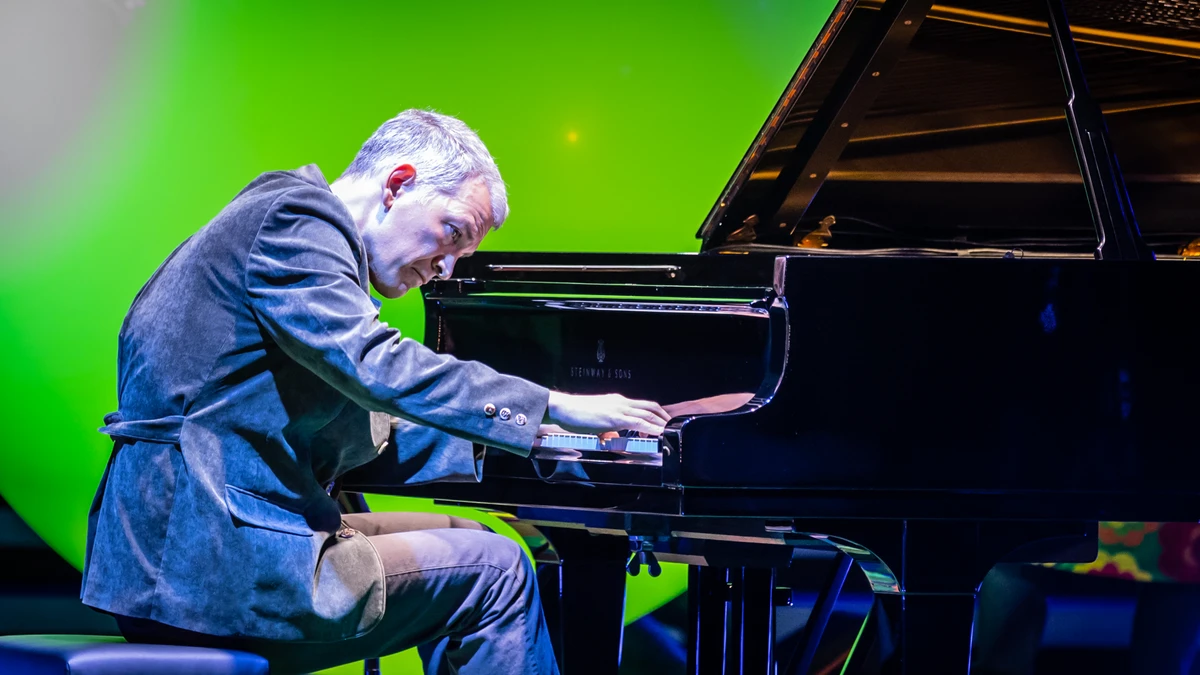
Brad Mehldau at the piano in 2021
Brad Mehldau at the piano in 2021
Brad Mehldau ended a night of honours the way he has spent much of his career, at the piano, thinking about Bach. On Sunday 25 October the pianist and composer received the Jazz Oeuvreprijs, the lifetime achievement award of the Dutch Edison awards, and closed the live television broadcast with a solo performance of improvised variations on the theme of Bach’s Goldberg Variations.
The award arrives three weeks before Fantasy & Reveries, Brad Mehldau’s new album of his own solo piano compositions, which Nonesuch releases on 13 November. Taken together, the two moments say a good deal about where he stands: honoured for a body of jazz work, and still writing concert music that draws on the classical tradition.
A Lifetime Award, Broadcast Live
The prize was presented at the Edison Klassiek ceremony in the Netherlands, which was televised live on NPO 2’s Podium Klassiek. The broadcast included an interview with Mehldau, and his performance closed the programme. He also gave an interview to the Dutch newspaper de Volkskrant to mark the occasion, his label noted.
The Edisons have been presented since 1960, and the jazz lifetime prize recognises a whole career rather than a single record. For a musician whose output runs from trio standards to Beatles interpretations, an Elliott Smith songbook and through-composed classical works, a career award is the only kind that can take in all of it at once.
It was also fitting that he was honoured at a classical ceremony. Much of Mehldau’s recent writing sits closer to the concert hall than the jazz club, and the Edison Klassiek setting suited that.
What the Jury Saw in Him
Presenter Floris Kortie handed Mehldau the prize, and the jury’s reasoning was specific. In its statement, published by the Edison organisation, it praised his unique talent for improvisation and what it called his incomparably strong ear for everything a melody contains. A summary of de Volkskrant’s interview adds that the jury also valued his ability to connect jazz, pop and classical music.
Mehldau, who is 56, told the paper he has no favourite style, and that what he looks for is harmonic depth and something new. The interview ran under a line of his that captures the method in a sentence: “Ik wil steeds iets anders met dat liedje doen dat er niet om vraagt”, roughly, “I always want to do something different with that song, something it isn’t asking for”, according to Headliner’s summary of the piece.
He shared the night with distinguished company. The classical lifetime prize went to the pianists Katia and Marielle Labèque, whom the jury credited with having “changed the face of classical music” by taking the piano duo to new heights. Cor Bakker won the jazz audience award for Momentum Vol.1, and the cellist Anastasia Kobekina was honoured for her recording of Bach’s Cello Suites, which made Mehldau’s Goldberg improvisation one of two Bach moments in the evening’s results.
Why Bach Was the Right Way to End the Night
Mehldau’s choice of encore was not an accident. Bach has run through his recent work: his Three Pieces After Bach responded to Bach directly, and a later Nonesuch release, After Bach II, came out in 2024 alongside Après Fauré. Improvising variations on the Goldberg theme on live television extended that conversation in public.
The Goldberg Variations are themselves a work about variation: an aria followed by a long sequence of transformations built on its harmony. For an improviser, the theme is an invitation, a fixed structure with almost unlimited room inside it. Ending a lifetime award broadcast that way was a neat summary of Mehldau’s method, which often turns on finding freedom inside a form.
It also previewed the album to come. Fantasy for Piano, the larger of the two works on Fantasy & Reveries, was written in the same period as Three Pieces After Bach and, in Mehldau’s words, shares its obsessions.
Inside Fantasy for Piano
The piece was originally commissioned by the pianist Jeremy Denk, according to Nonesuch’s announcement of the album. Mehldau’s liner notes describe it in unusually technical terms. It “shares similar obsessions with Three Pieces After Bach: long, extended pedal-points, sharp juxtapositions between triadic consonance and extreme dissonance, and a freely subdivided 7/4 meter,” he writes.
He is candid about how hard it is to play. “It is written very densely, and the challenge is often to convey the melodic storyline within a very thick texture,” he says in notes quoted with the release of the piece’s scrolling score video. That challenge, keeping a single line audible inside a mass of notes, is one any listener can follow, even without reading the score.
The 7/4 meter matters too. Seven beats to the bar, freely subdivided, keeps the music from settling into a regular pulse, which suits a fantasy: a form that by definition follows the composer’s imagination rather than a set structure.
Fourteen Short Pieces About Solitude
The second work, Fourteen Reveries, takes the opposite approach. Like Mehldau’s Suite: April 2020, which he recorded during the COVID-19 lockdown, it is a collection of shorter pieces. “I’ve eschewed larger-scale development, opting for brevity,” he writes. “Each piece is more like a distillation of emotion.”
He describes music that “might accompany those moments during waking hours, when we withdraw from our exterior environment”. The mood is precise. The music, he says, “expresses solitude”, which he breaks down as “enraptured, placid, nervous, lonely or ecstatic” by turns.
That list of moods is a useful listening guide. A reverie is a private state, and fourteen of them, each short, sound designed to be heard the way they were imagined, one at a time and without hurry. For listeners who loved the intimacy of Suite: April 2020, this looks like its closest relative in his catalogue.
What You Can Hear Before Release
Three pieces are already out. Reveries 1 and 2 arrived in September, and Fantasy for Piano followed on 13 October, each with a scrolling score video that lets listeners follow the notation as Mehldau plays. For a work as dense as the Fantasy, seeing the score scroll past is the clearest way to hear what he means about the melodic storyline buried in the texture.
The album is available to pre-order now through Nonesuch, ahead of its 13 November release. Readers who follow pianists moving between worlds may also want our report on how Víkingur Ólafsson stepped in for Trifonov on the Berlin Phil’s Brahms tour.
Twenty-Two Years on Nonesuch
Fantasy & Reveries will be Mehldau’s 23rd release on Nonesuch, a relationship that began with Live in Tokyo in 2004. The recent catalogue shows how wide his range has become: Jacob’s Ladder in 2022, Your Mother Should Know: Brad Mehldau Plays The Beatles in 2023, After Bach II and Après Fauré in 2024, and Ride into the Sun, his tribute to Elliott Smith, in August 2025.
He has also turned writer. His memoir, Formation: Building a Personal Canon, Part I, was published in 2023. A lifetime award might suggest a career winding down; the release schedule suggests the opposite. On the evidence of the past three years, the Edison jury has honoured a musician still working at full speed, and Fantasy & Reveries will be the next proof of it.
About The Author