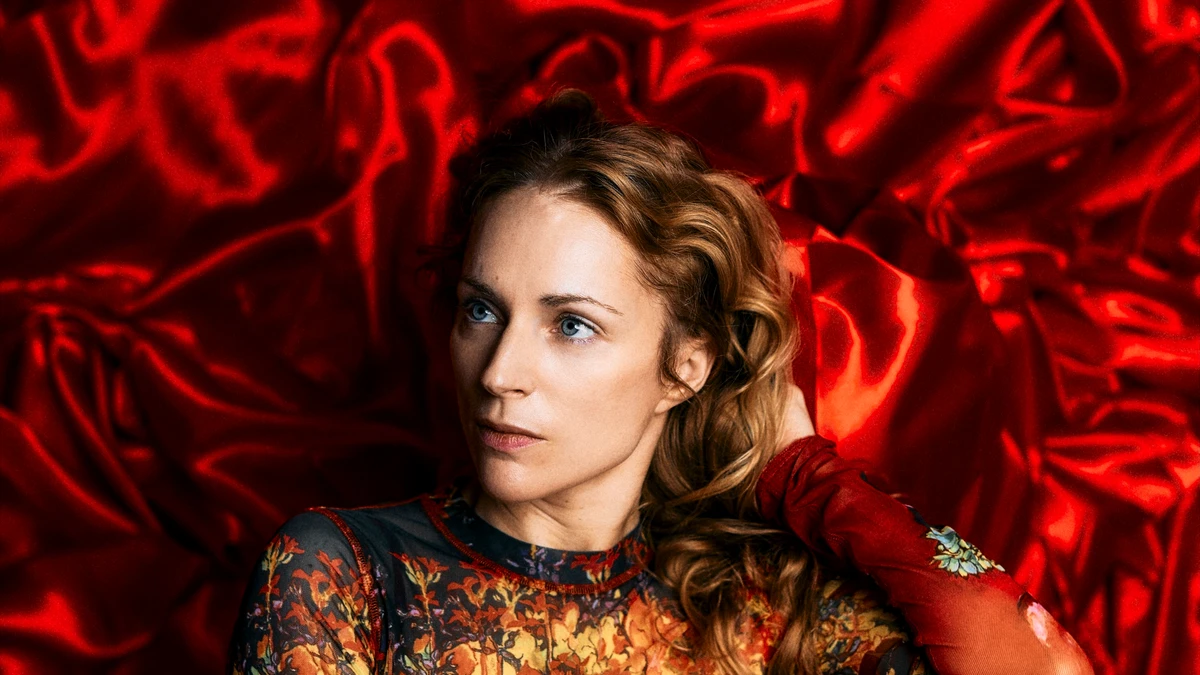
Agnes Obel has usually started her songs at the piano. For most of The Meaning of Flowers, she started somewhere else: with a bass synth and a low, pulsing tone. She told The Line of Best Fit that while she was pregnant her ear needed something that felt like a heartbeat, and that this compressed, pulsing sound was the one she had to work with.
That decision shaped her first album in six years. The Meaning of Flowers is released on 18 September through Deutsche Grammophon, as the follow-up to Myopia from 2020, and it runs to 12 tracks written, recorded, arranged and produced by Agnes Obel in her own studio in Berlin. Sortiraparis counts it as her fifth studio album and places it at the crossroads of classical music, chamber pop and experimentation.
A Pulse Before the Melody
The change of starting point followed a change in how she experienced the world. Obel described pregnancy to The Line of Best Fit as a profound rewiring, to the point where she felt everything around her had a kind of consciousness, and said she wanted to find a way to take the energy she sensed running through everything and turn it into sound.
The lead single, Laymelli, came later, after her daughter was born. Obel said she wanted to write about the life current that runs through everything, and found insects the clearest image for it: creatures that pass through complete changes of form while remaining the same individual. She wanted the song to sound very old and slightly funny at the same time, and The Line of Best Fit notes that metamorphosis, the subject of the Coccia writing that inspired it, was an early working title.
The voice on Laymelli is treated as another instrument. Obel explained that she did not want to sing the whole song in her normal voice, so she used pitch shifting to put some distance between the vocal and herself, at one point imagining the singer as an insect or a kind of consciousness. Sortiraparis, describing the album material, notes that her voice is deliberately transposed in pitch at times across the record.
A Berlin Studio and the Ensemble Around It
Obel handles most of the parts herself. According to Music-News, she sings and plays piano, keys, synthesisers and samples, while a supporting ensemble adds violin, viola, cello, bass, lap steel, harmonium, flute, saxophone, percussion and backing vocals.
Some of those contributions are close to home. On Jenn’s on the Way, a song about a friend who is famously late, the friend herself sings a little of the choir part, Obel told The Line of Best Fit.
The instrumentation changes from song to song. The album’s only instrumental, Tangerine, pairs saxophone arpeggios with celesta and piano, and Don’t Look Down draws on 1970s film scores, Music-News reports. The Pause and Play release listings describe Obel as a Danish-born, Berlin-based singer-songwriter and confirm that she wrote, recorded, arranged and produced the record in her own studio.
Keeping the First Take of Beyond the Sun
One recording on the album is deliberately unfinished. Obel told The Line of Best Fit that the version of Beyond the Sun on the record is the demo she made very quickly, more or less as she was writing the song. She has since written another verse and another chorus, and plans to record it again on piano later this year.
She kept the demo because it captured something she rarely gets: a song where the idea and the recording came together on the same day. She said it did not matter that half the song was missing, because the original feeling was present in that take.
The decision reflects a wider shift in how she works. Obel said she used a click track on many of the songs for this album but does not expect to use one on her next project, because she is moving away from needing things to be perfect and towards keeping recordings as close as possible to the first idea.
That urgency sometimes gets physical too. She described her phone as full of rough recordings of half-formed ideas, captured before they disappear, and admitted that in the rush to record something she has broken things, including spilling coffee into her piano.
The Album She Stopped Making
The Meaning of Flowers was not the record Obel set out to make. After she had to shut down her Myopia tour and return home to Berlin, she did what she had always done after touring and began another album, The Line of Best Fit reports. That project was about technology and the machine age, and how it has reshaped ideas of human nature.
The discovery that she was pregnant, six summers ago amid a global crisis, ended it. Obel said she knew she could not continue with that work, and started something else instead. She described the album that followed as the record of a journey across five or six years, and credits her daughter with changing her so much that, in her view, the child has been raising her as much as the other way round.
Hymns, Philosophy and Plant Biology
The album has an unusual reading list. Music-News lists Hannah Arendt’s writing on new beginnings, Emanuele Coccia’s texts on plant biology, the ancient poetry of Enheduanna and 1980s Danish pop music among its influences, and notes that the album is dedicated to Obel’s daughter.
Coccia’s book Metamorphoses was the starting point. Obel said its ideas about people constantly blending with one another, and about birth, time and death being less separate than they seem, gave her a philosophy she could relate to in her new state, and led her towards much older writing.
Enheduanna shaped Blood So Red. Obel told The Line of Best Fit that she was struck that the oldest named author in history was a woman, a Sumerian priestess whose hymns to the goddess Inanna describe a power that makes the earth shake. The song, she said, is really about birth, which she gave in a Berlin hospital and imagined afterwards as a storm of orange clouds slowly settling. In the first days with her daughter, she remembered small flowers coming up through the snow outside the window, and a sense of peace returning.
The title track changed its name along the way. Obel said its original title came from a phrase in Arendt’s 1958 book The Human Condition, about birth as the miracle that saves the world, before Coccia’s explanation that the beauty of flowers exists for bees rather than for people gave the album its final name. Arendt’s idea appealed to her because it treats the capacity for new beginnings as a political force, an answer to totalitarianism rather than a fixation on death. Gemini and Laymelli, Music-News adds, draw on seed cycles and metamorphosis.
Where It Goes on Stage
Obel did not plan the album’s shape. She told The Line of Best Fit that the first half explores a mind-expanding sense of connection and the second half turns inward, towards identity and the difficulty of being an individual, and that this mirrors how she came back to her old self as her daughter grew. No Such Thing as Silence, one of the more personal songs, treats silence as a physical force between people. The record closes with Faustian Deal.
The songs are already travelling. Music-News reports European outdoor festival dates in August and an international tour from September that includes Hamer Hall in Melbourne, the Sydney Opera House and the New Zealand International Convention Centre in Auckland. Obel also played Somerset House in London this summer.
A longer run follows. Sortiraparis reports a 23-date European and UK tour in 2027, with French dates at the Olympia in Paris on 23 September, Toulouse on 17 October and Lyon on 6 November. General sale for those shows opens on release day. The album is released digitally, on CD and on vinyl.
A home studio has shaped more than one recent acoustic record. AcousticMusic.News covered another example when Víkingur Ólafsson recorded a Bach album in his own basement. Agnes Obel took the same freedom somewhere stranger, starting from a pulse, keeping a first-day take and letting a pregnancy rewrite the record she had planned.
About The Author