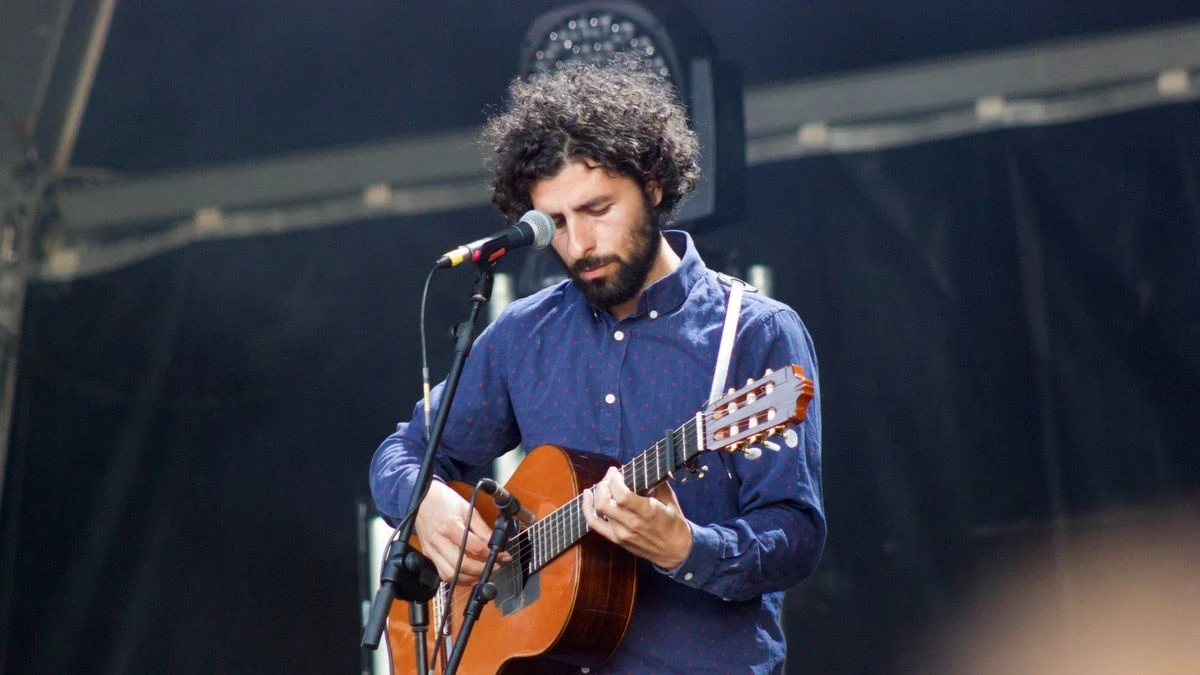
José González performing.
José González performing.
The phrase belongs to Dylan Thomas, from the villanelle he wrote for his dying father. José González has borrowed it for an album about something larger and less personal: whether the species is going gently.
Against the Dying of the Light arrived on 27 March through Mute Records in North America and City Slang elsewhere. It is his fifth studio album and the first collection of original songs he has released in nearly five years.
Thirteen Songs in Three Languages
The sequence runs “A Perfect Storm”, “Etyd”, “Against the Dying of the Light”, “For Every Dusk”, “Sheet”, “Pajarito”, “Losing Game (Sick)”, “Ay Querida”, “Rawls Slöja”, “Gymnasten”, “Just a Rock”, “You & We” and “Joy (Can’t Help But Sing)”.
Read down that list and the languages shift under you. “Etyd”, “Rawls Slöja” and “Gymnasten” are Swedish; “Pajarito” and “Ay Querida” are Spanish; the rest are English. A record made by a Swedish songwriter of Argentine descent does not have to explain itself, and this one does not.
The multilingualism is not decoration. A song titled in Swedish and sung to an international audience is a statement about who the record is addressed to, and refusing to translate is a way of declining to pick a single audience.
Two of the titles also sit oddly against the rest. “Gymnasten” — the gymnast — and “Etyd” — an étude — are the words of practice and discipline rather than of politics, and on a record this concerned with the state of the world they read like a songwriter reminding himself that the work is still the work.
Tribes of Sentient Apes
González’s own framing of the album, given to Northern Transmissions, is unusually direct about scale. “As a concerned world citizen, I wrote these songs as a reflection of our times. Times of amazing progress, but also worrying backslides.”
His description of the subject is bleaker and funnier than most songwriters would risk. Humanity, he says, is a matter of “tribes of sentient apes with stories that sometimes are incompatible with each other and tools that could eventually lead to dystopia”.
That is a sentence with a philosophy behind it, and the album’s stated project follows from it: the songs address “how we can navigate humanity towards flourishing on an individual and a collective level”. A folk record with a stated interest in collective flourishing is either insufferable or serious, and the restraint of the writing keeps it on the right side.
It is also a difficult thing to sing. Abstractions defeat most songwriters, and a lyric about incompatible narratives and dangerous tools can very easily become a lecture with a chord sequence under it. González has spent a career keeping his words plain, which is the only technique that makes this subject survivable.
A Song About Accepting What Happened
The title track is the clearest statement. González describes it as “a song reflecting on humanity in 2025… about accepting who we are and what led us here, since the past can’t be changed.”
Acceptance is a strange note for an album named after a poem about raging. Thomas’s line is an argument against acquiescence; González has taken the phrase and pointed it at a different target — not the individual death the poem addresses, but the light itself.
“Rawls Slöja” carries the argument into its title. The Swedish word means veil, and the title appears to point at John Rawls’s thought experiment, in which a person designs a society without knowing which position in it they will occupy. Putting political philosophy into a song title on a quiet acoustic album is a genuinely unusual move.
The Companion to Local Valley
The record has been presented as a companion to Local Valley and a further meditation on its themes, widening the earlier album’s gaze into what the announcement calls an urgent call to preserve the light of humanity.
Nearly five years between records of original material is a long gap by any standard, and it is worth noting what did not happen in between: no rushed follow-up, no pandemic album, no covers project standing in for new writing. The songs took the time they took.
It is the same working principle Richard Thompson describes when he waits for songs to reveal which of them are siblings — the album arrives when the material does, not when a release schedule requires it.
The gap also changes what an album has to do. A record arriving five years after the last one cannot be a report on a moment; too much has happened. What it can be is a summary, and the reach of these songs — species, tools, societies designed from behind a veil — is the reach of somebody writing about a period rather than a week.
One Guitar, Still
What has not changed across his career is the instrument. González’s records are built on a nylon-string guitar played fingerstyle, with a voice close to the microphone and very little else, and the restraint is what has made him identifiable from the first bar since the beginning.
That places a real limit on what an album can do, and it is the reason the reviews of this one have divided. Some hear a continuation of the signature style with a touch of desert blues; at least one found the record too uniform to hold thirteen tracks.
Both readings describe the same fact. A songwriter working with one texture is asking the listener to attend to the writing rather than the arrangement, and a listener who does not want to do that will hear repetition. The trade has been the same on every record he has made.
It also makes the touring straightforward in a way most artists would envy. There is no production to freight around, no band to keep on salary between legs, and the record can be performed exactly as it sounds by one person with a chair. That economy is why a catalogue like his stays viable across decades.
Thirteen Nights, Ending at the Bowl
Pollstar laid out the autumn run: Montreal’s MTELUS on 11 September, the Danforth in Toronto on the 12th, Calgary’s Palace Theatre on the 13th and the Orpheum in Vancouver on the 15th.
The American leg takes the Fox in Tucson, Mesa Arts Center, the UCSD Epstein Family Amphitheatre in San Diego, then the Hollywood Bowl on 20 September, followed by Artown in Reno, the Mountain Winery at Saratoga, Channel 24 in Sacramento, the Uptown in Napa and UCSB Campbell Hall in Santa Barbara on the 26th.
The Bowl date is the outlier. mxdwn reports it as a bill with Gregory Alan Isakov and the Hollywood Bowl Orchestra — a full orchestra behind music built on a single nylon-string guitar.
Isakov is a well-chosen partner for it. He works the same quiet, unhurried end of American songwriting, and a bill that pairs two players of that kind with a full orchestra is a bet that a large audience will sit still for it — which, on a warm September night in Los Angeles, is a reasonable bet.
That contrast is the year in miniature. An album about tribes of sentient apes, written in three languages and played on one instrument, ending up in front of one of the largest amphitheatre audiences in America and a symphony orchestra. Whatever else the light is doing, it is not dying quietly.
About The Author