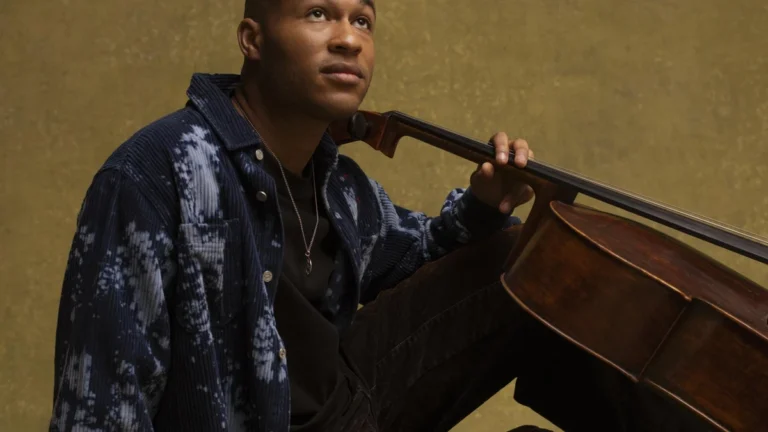
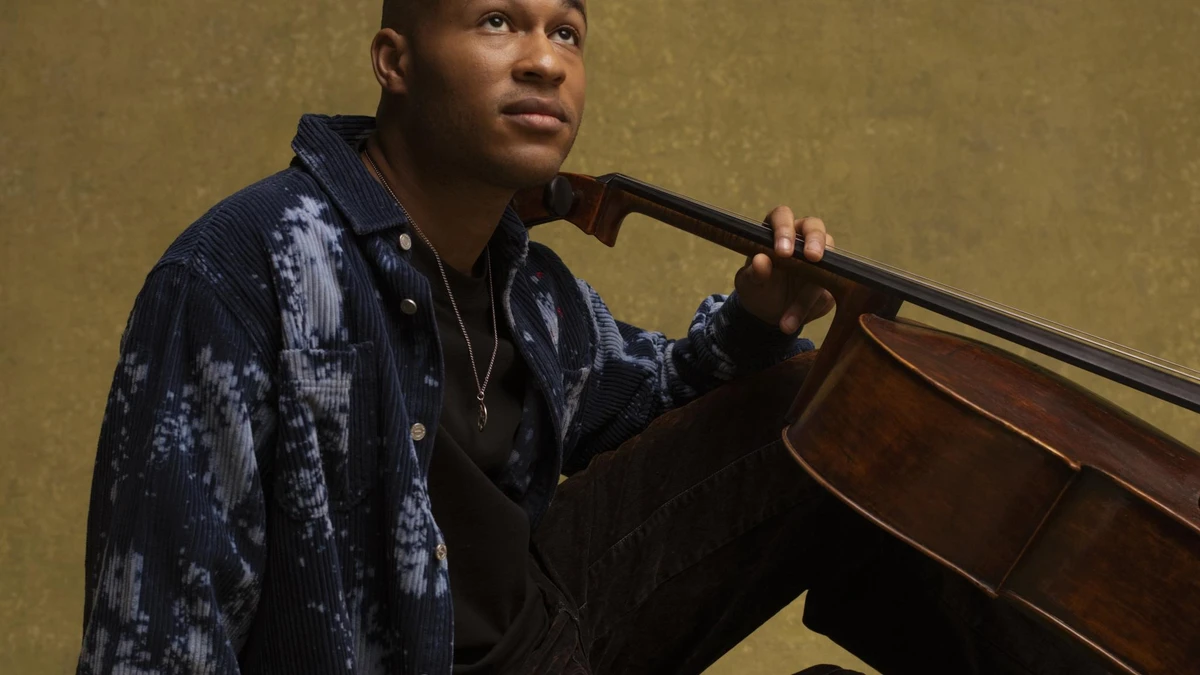
Sheku Kanneh-Mason in a Decca Classics portrait
Sheku Kanneh-Mason in a Decca Classics portrait
Sheku Kanneh-Mason hears a storm at the start of his new album. “Plunged immediately into a storm at sea with huge waves all around, thunder and lightning,” is how the cellist describes the opening of Saint-Saëns’ Cello Concerto No. 1, the work that begins “Hope in Shadow”, his ninth studio album for Decca Classics, released on 13 November.
The record, made with Edward Gardner and the London Philharmonic Orchestra, gathers music he has loved for a long time, first as a listener and now as a performer. When Decca Classics announced it, the label published his own notes on almost every piece, and they make a better guide to the 14 tracks than any sleeve note: each one names the moment he listens for. “All the works feel as if they stretch the boundaries of sound in extreme and different ways,” he said.
Saint-Saëns Opens the Album in a Storm
The Cello Concerto No. 1 was written in 1872 and broke with the structural convention of its day, running as one continuous movement rather than the usual three, Decca noted. It is a piece Kanneh-Mason was drawn to as a child, and one of the first concertos he learned.
His reading of it is a story with a clear arc. After the storm, he said, “it’s as if the whole piece is about escaping this, via different means and methods: dream-like elegance, passionate singing and determined virtuosity.” Listening with that in mind, the concerto’s three sections become three ways out of the same weather.
Saint-Saëns returns later in the running order with “The Swan”, the penultimate movement of “The Carnival of the Animals”. Kanneh-Mason calls it “a piece of sheer beauty in amongst others that contain a great deal of darkness”, and adds: “Its appeal never wanes; I would think every cellist plays it or has dreams of doing so.”
Kol Nidrei Climbs to the Top of the Cello
Bruch’s “Kol Nidrei” uses the cello as a cantor, setting two Jewish themes traditionally recited on Yom Kippur, according to Decca. Kanneh-Mason’s favourite moment in it comes in the final bars.
“For me the most precious moment comes at the end where there are three ascending D Major scales and arpeggios; the first one reaches the middle register of the cello, the second a little higher, and the final is all the way to the very top of the instrument,” he said. “It’s like a bird flying ever higher into the sky; a beautiful musical image of looking upwards for light and the most perfect way to end a piece that begins so solemnly.”
It is the album’s title in miniature: a work that starts in a low, solemn register and ends reaching for the highest notes the instrument has. For a first listen, those closing scales are the passage to wait for.
Ravel’s Kaddish Sounds Closer to Speech
Ravel’s “Kaddish” is a Hebrew melody based on the sacred Aramaic Jewish prayer, and it appears here in an arrangement by Richard Tognetti. It was the album’s second single, released on 18 September.
“Because of the way it’s written, with the melody repeating in tones rather than bigger intervals, Ravel’s Kaddish has always felt to me more like speech than song,” Kanneh-Mason said. “It’s the closest you get to the core of the instrument itself, delivering its purest message.”
That description is a practical listening note. With the line moving in small steps rather than leaps, the interest sits in how each repeated note is weighted, which is exactly where a cellist’s bow control shows.
Schelomo Ends at the Bottom of the Instrument
Bloch’s “Schelomo”, a rhapsody that falls into three sections, uses the cello as a voice speaking to the world, while its extreme orchestration conjures images of chaos and tragedy and voices the thoughts of King Solomon, Decca’s notes say.
“I don’t know of another piece that has such extreme orchestral moments and there are often three or four different musical images being painted at the same time!” Kanneh-Mason said. The ending goes the other way entirely: “It ends in complete darkness right at the depths of the cello, one of its lowest notes and is joined by the sombre resonance of the double basses, bassoon and contra bassoon.”
If the close of “Kol Nidrei” is the record’s highest point, the close of “Schelomo” is its lowest, and the two sit a few tracks apart. It is the moment where the album stays longest in its shadow before Bloch’s suite “From Jewish Life” follows.
Bloch’s Suite and John Williams Close the Record
“From Jewish Life”, a three-movement suite Bloch wrote for the cellist Hans Kindler in 1924, appears complete: “Prayer”, “Supplication” and “Jewish Song”. Its first movement is the Prayer he first played at nine, a piece he remembers “just being in love with” along with “the idea of what the cello could sound like”.
The album closes with John Williams’ theme from “Schindler’s List”, Steven Spielberg’s 1993 film, arranged for cello and orchestra. The theme was played on the original soundtrack by the violinist Itzhak Perlman, and Kanneh-Mason’s note credits him directly: “John Williams’ theme is so moving, Itzhak Perlman’s violin captures the scene exquisitely.”
The Williams theme was the first single, released on 28 August, the day the album was announced. “Kaddish” followed on 18 September and “Prayer” on 16 October, and the opening movement of the Saint-Saëns concerto arrived with the album itself on 13 November.
What the First Reviews Heard
Early reception has been warm but not uncritical. In a review written in German for Concerti, Jan-Hendrik Maier described Kanneh-Mason’s tone as warm and singing, and noted that he never puts too much pressure on the bow, which makes “Prayer” an intimate performance.
Maier was less convinced by the concept. He found the album’s thread, music the cellist has long loved, a rather vague basis, and argued that while the Jewish-themed works and the Williams theme share common ground, the Saint-Saëns concerto and “The Swan” fit less easily. He thought the risk of over-sweetness was largely avoided, found the Schindler’s List track borderline in places, credited the London Philharmonic under Gardner with a fine sense of proportion, and summed up that much is good and little is unmistakable.
John Buxton, who writes the Classical Guy newsletter, made it the 30th entry in his running series on the best new classical albums of 2026. “I think we can now acknowledge Kanneh-Mason as one of the great young artists in classical music today, and a legitimate superstar,” he wrote.
Listeners have found it too. “Hope in Shadow” was No. 8 on Apple Music Classical’s global albums chart for the week of 16 to 22 November, The Violin Channel reported, a chart that combines Apple Music Classical, Apple Music and iTunes.
A Decade at Decca and the Season Ahead
The release marks ten years since Sheku Kanneh-Mason signed with Decca Classics and won BBC Young Musician, and his recordings have now passed half a billion streams, the label said. His arrangements and transcriptions are published by Faber, he has written two books published by Penguin Random House, and he is Menuhin Visiting Professor of Performance Mentoring at the Royal Academy of Music, where he studied, according to The Violin Channel.
His 2026/27 season includes concerts with the Rotterdam Philharmonic, the Danish National Symphony, the Polish National Radio Symphony, the Pittsburgh Symphony and the Royal Concertgebouw Orchestra, plus a recital tour of Europe and North America with the pianist Benjamin Grosvenor.
For an album built on light arriving out of darkness, his own summary is the plainest: “In the musical depths of desperation comes beauty, determination and what feels like a pearl of inspiration out of nowhere.” The storm at the start, the climb at the end of “Kol Nidrei” and the low note at the bottom of “Schelomo” are where to hear it.
About The Author