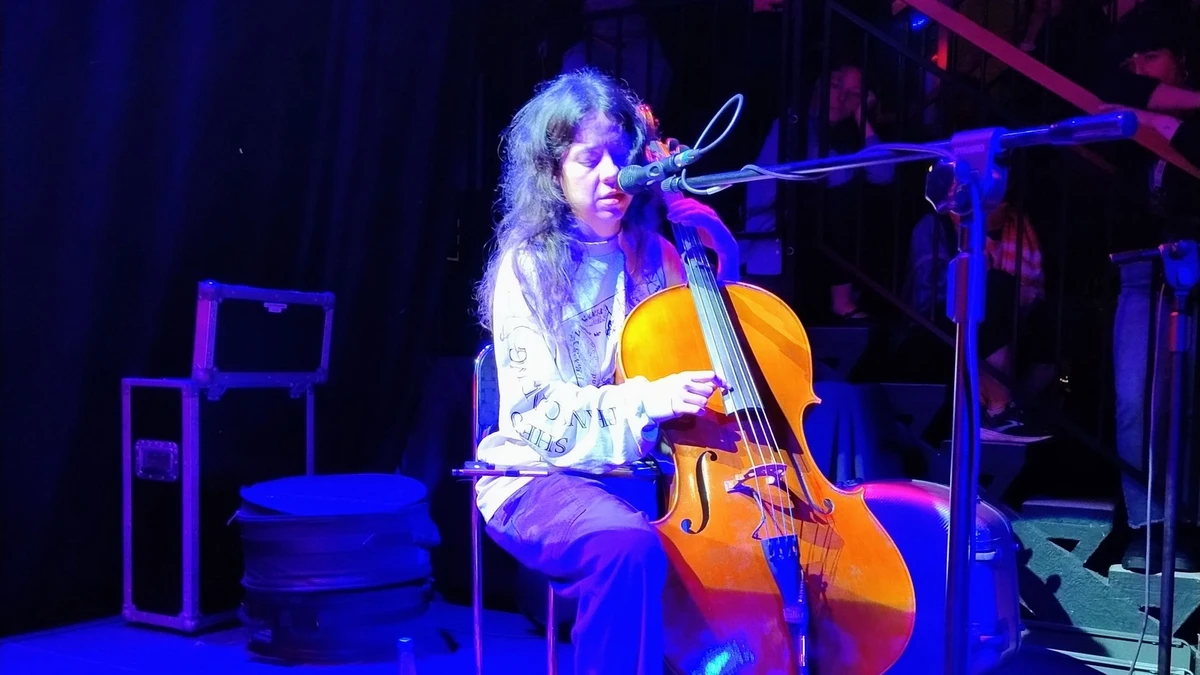
Mabe Fratti performing at Pardon To Tu in Warsaw.
Mabe Fratti performing at Pardon To Tu in Warsaw.
Bill Orcutt read an online interview in which Mabe Fratti said something kind about a record he made in 2017. He emailed her. The result, eight tracks later, is one of the more unlikely duo albums of the year — and the two musicians on it were never in the same room.
Almost Waking arrived on 22 May through Tin Angel Records: guitar and cello, eight tracks, six instrumentals and two songs.
An Email and a Long Exchange
The Line of Best Fit describes what followed the first message as “a prolonged exchange of musical ideas”, in which Fratti added texture and detail to Orcutt’s embryonic solo guitar explorations.
She did not work alone. Héctor Tosta, who records as I. La Católica and plays with Fratti in Titanic, worked alongside her on the additions. So the record is a duo in name and something closer to a three-way correspondence in practice.
Remote recording usually announces itself. Parts sit at slightly wrong distances from each other, and the players respond to a recording rather than to a person. POST-TRASH found the opposite here, calling the cohesion remarkable precisely because of how it was made.
The origin is worth dwelling on because of how thin it is. No label put them together, no festival commissioned it, no manager saw a market. One musician read a compliment and wrote to a stranger, and an album exists because she wrote back.
What Fratti Chose Not to Do
The interesting decision is a negative one. Orcutt’s playing is famously raw — abrasive, pentatonic, string-snapping — and a cellist arriving on top of it has an obvious option available: smooth it out, add warmth, make it palatable.
She declined. The Line of Best Fit notes that Fratti’s cello and occasional vocals “wisely steer clear of trying to sweeten or sterilise” his approach, and describes the result as “chamber music that happens to have a healthy lining of dirt under its nails”.
That phrase is the best short description of the record available. The instrumentation is a chamber duo; the manners are not. On “Forced & Forced & Forced”, POST-TRASH hears Orcutt’s string-snapping pentatonic runs clashing with Fratti’s fragmented, abrasive bow-scraping — two players arguing rather than accompanying.
Restraint of that kind is harder than it sounds. A cellist working over rough guitar has every technical means available to smooth the edges, and the discipline of leaving them is the difference between a collaboration and a remix.
Eight Tracks, Two With Words
Six of the eight are instrumental. “Steps of the Sun” and the title track are where the two lines run closest, with what POST-TRASH calls seamless harmonic interplay and The Line of Best Fit describes as “beautifully pensive”.
The vocal tracks are in Spanish. On “El inicio es cuestión de suerte” — the beginning is a matter of luck — Fratti’s multi-tracked vocals loop over a repeated guitar figure; on “Todo puede ser error”, Orcutt snakes his jangling solos around what the review calls her echoing incantations.
“Arise from Graves and Aspire” goes the other way entirely, a spatial study that lets sustained notes ring out into silence. Putting that next to the abrasion elsewhere is the record’s whole range in two tracks.
Treble makes a point worth repeating: on an album three-quarters instrumental, the most immediate hooks are usually in the pieces without a voice. That is unusual, and it says something about how strong the two instrumental lines are on their own.
Where the Cello Sits in Acoustic Music
A cello is not a folk instrument in the way a fiddle is, and its arrival in this kind of record is comparatively recent. The instrument spent centuries inside the classical ensemble, where its job was to hold the bottom of a harmony somebody else had written, and improvising on it is a skill the training does not teach.
Fratti belongs to a generation that has taken it elsewhere entirely — into art-pop, into improvisation, into songs where the cello and the voice belong to the same person. On a record with no bass and no drums, hers is simultaneously the low end, the counter-melody and the second voice, and the arrangements only work because she moves between those jobs without announcing it.
That flexibility is what makes the duo format viable at all. A guitar and a cello are both mid-range instruments with overlapping registers, and two players occupying the same frequencies for eight tracks would ordinarily turn to mud. Keeping them legible for half an hour is a feat of arrangement disguised as spontaneity.
Why So Little of It Survived
The brevity is a genuine artistic decision rather than a shortage of material. An exchange of files running over months would have produced far more than eight pieces, and what did not survive the edit is as much a part of the record as what did.
Improvised duo records have a characteristic failure mode: they go on. Two players in conversation can keep talking indefinitely, and the edit is where the album is actually made. Eight tracks is a small fraction of what an exchange lasting months would have produced.
It also suits the format. Guitar and cello with nothing else is a thin texture by design, and a listener’s attention to two unaccompanied lines has a natural limit. Stopping before that limit is why the record sounds concentrated rather than sparse.
Singing in Spanish over an American experimental guitarist is its own quiet statement. Fratti is Guatemalan and based in Mexico City, and keeping her own language on a record built from someone else’s material means the collaboration never resolves into one voice absorbing the other.
Two Careers That Should Not Have Met
Orcutt’s reputation rests on experimental and improvisational guitar rather than on anything a listener would call folk, and Fratti’s recent work in Mexico City has been progressive art-pop with an ornate, composed quality. Neither was heading towards a duo record of quiet acoustic dialogue.
Treble frames the meeting as one born of mutual admiration, with both artists deliberately keeping the approach simple: duo arrangements for guitar and cello, and in two instances a voice. Everything either of them normally does — the turbulence, the grandeur — was set aside.
There is a practical lesson buried in it as well. The file exchange that produced this record is the same infrastructure that produces a great deal of thin, characterless remote music, and the difference here is not the technology but the time — months of sending things back rather than a single afternoon of session work.
What is left is the sound of two collaborators playing as though they are casually together in a room without an audience. That they were nothing of the sort is the album’s quiet joke, and the reason it belongs in a conversation about acoustic music rather than about technology.
It is a different route to the intimacy Bill Frisell chased by putting six players in the same room — one built from files rather than sightlines, and arriving somewhere adjacent. POST-TRASH’s verdict is the one to end on: by the close, “you’ve been listening to one of the most beautiful albums of the year”.
About The Author