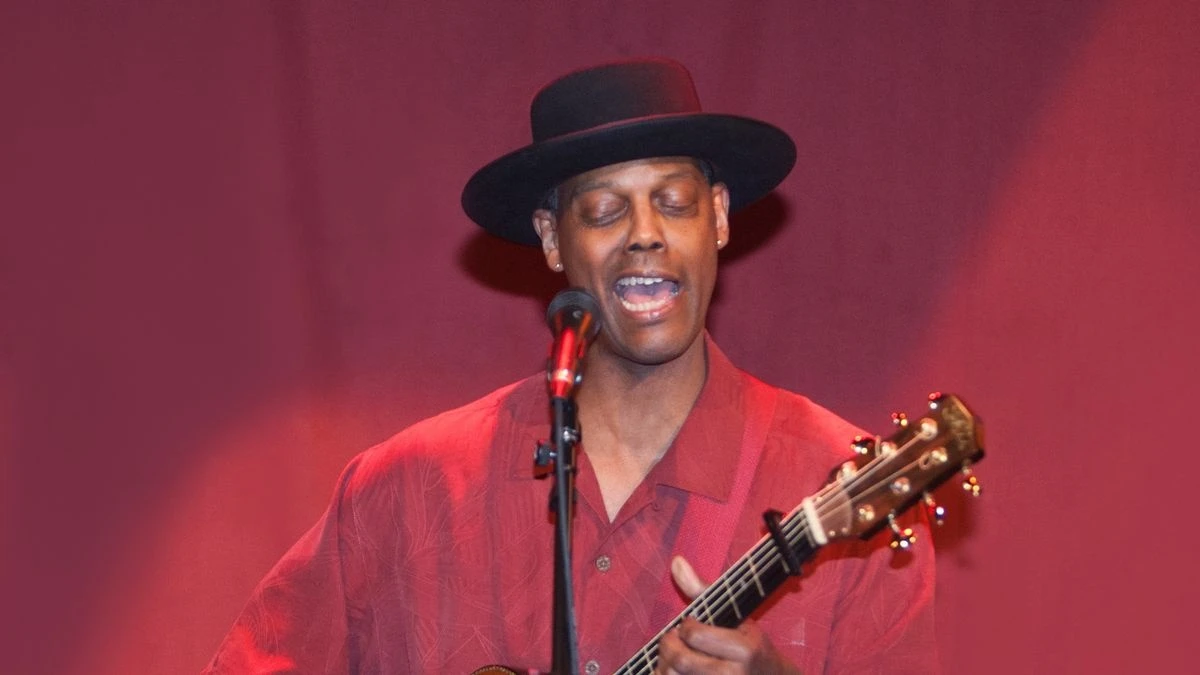
Eric Bibb performing.
Eric Bibb performing.
When Eric Bibb was eleven he told Bob Dylan that he played guitar too. Dylan, not much older himself, gave him two words of advice: keep it simple. A career of records later, Bibb has decided it was correct.
“Looking back on that conversation, I’ve come to realize the value of those words,” he told Yardbarker. “Perhaps not consciously, but on some level, that sincere advice, from a very precocious young Bob Dylan, has guided me.”
Fourteen Songs From Uppsala
One Mississippi arrived on 30 January through Repute Records. The sequence runs the title track, “Muddy Waters”, “This One Don’t”, “Didn’t I Keep Runnin'”, “Go Down Ol’ Hannah”, “It’s A Good Life”, “No Clothes On”, “Crossroads Marilyn Monroe”, “New Window”, “If You’re Free”, “Change”, “Waiting On The Sun”, “Show Your Love” and “We Got To Find A Way”.
Thirteen are Bibb’s own, written or co-written with his producer. It was recorded at Glen Scott’s private studio in Uppsala, Sweden — a Mississippi album made a long way north of Mississippi, which is a fair description of Bibb’s whole career.
He has been clear about what it is for. The record is “a collection of stories, from a not-too-distant American past and a tense global present”, and, he says, “a call for peace, justice & unity”.
The titles carry that split openly. “Muddy Waters” and “Go Down Ol’ Hannah” reach back into the tradition, the second a work song older than recording itself, while “Change”, “If You’re Free” and “We Got To Find A Way” are addressed at the present. Sequencing them together rather than in blocks means the record refuses to be either a history lesson or a protest album.
“Crossroads Marilyn Monroe” is the outlier and the most intriguing title on the list. The crossroads is the oldest image in the blues; attaching a twentieth-century film star to it is the kind of collision a songwriter makes when he has stopped worrying about which century his idiom belongs to.
The Song His School Friend Wrote
The exception to the originals is the title track, written by Janis Ian with Fred Koller. Ian and Bibb were at high school together, which makes the choice something other than a straightforward cover.
His reasons are craft ones. “The southern imagery describing the place known as ‘the cradle of the blues’ is very refined and cinematic,” he said. “The song paints a picture of a landscape that is often the backdrop of many of the songs I write.” Then, characteristically: “Plus, as a title, it’s catchy!”
The lead single went the other way entirely. “This One Don’t” is, in Bibb’s description, “one of the funkiest I’ve ever recorded”, and he attaches a line from Alice Walker to it: “Hard times require furious dancing.”
Twenty Years With the Same Producer
Glen Scott has produced Bibb for more than two decades, and the account of how they work is unusually specific about what long partnerships actually buy. “Collaborating with Glen was highly enjoyable — a nuanced and soulful conversation, both musically and spiritually.”
“With the One Mississippi album, our work process is truly in the flow — sharing an almost telepathic communication.” Scott plays drums, bass, Hammond and sings as well as engineering, which Bibb rates highly: “Glen’s expertise as an engineer, together with his immense talents as a multi-instrumentalist, singer, and composer/arranger, make him, for me, the dream producer.”
The guest list is international. Grateful Web lists Robbie McIntosh on guitar, Paul Jones and Greger Andersson on harmonica, and a group of Swedish players including the fiddler Esbjörn Hazelius.
McIntosh has played with Paul McCartney, the Pretenders and John Mayer, and Bibb’s compliment goes past technique: “Not only is Robbie McIntosh a fabulous guitarist when it comes to blues, but he’s a master of the language.”
A 1930s French Banjo
Bibb owns a large collection of vintage instruments, and his method for choosing between them is not systematic. “Often, the guitar I decide to pick up is purely intuitive. The choice seems to be connected with a song that’s waiting to come through.”
It also determines the finished record. “For the most part, the guitar I’m playing as I compose will influence the style and feel of the song, and I’ll stay with that instrument for the recording, as well.” The instrument does not just play the song; it writes it.
That instinct explains why a Bibb record never sounds arranged around a voice. The guitar arrives first and the song is built to suit it, which is the working method of the country-blues players he came out of rather than of a Nashville-style writing room.
His named favourite is a six-string French banjo from the 1930s — the kind, he notes, that Django Reinhardt started on before switching to guitar. That an acoustic blues player’s prize instrument is a banjo associated with Parisian gypsy jazz says a good deal about how porous these traditions actually are.
The vocation was settled early. “From a very early age, music has always been the beacon guiding my life’s journey,” he said. “I have never seriously considered another calling. I always wanted to be a self-accompanying singer/storyteller.”
On Machines and the Streaming Split
Asked about the state of the industry, Bibb gave the most interesting answer in the interview. “The current fascination with AI and other technologies will hopefully lead to a deeper appreciation of musicians devoted to mastering instruments and composing by being open to divine inspiration.”
He is not dismissive. “Artificial Intelligence surely has positive applications, but for me, unlocking the secrets of guitar playing is more alluring.” The second half of the answer is blunter: “I look forward to a more equitable sharing of streaming profits. Musicians certainly deserve a bigger slice of the pie than they’re receiving!”
On what music is for, he does not hedge. “I think the power of music is immeasurable. As a galvanizing, pacifying, healing force, music is a divine gift that is surely helping us through these challenging times of transition.” Coming from a man releasing an album called a call for peace and unity, the two statements are the same statement.
Sixteen Dates Across Britain
Americana UK listed the run: two nights at 229 in London on 5 and 6 January, then a March tour opening at the De la Warr Pavilion in Bexhill on the 11th and the Stoller Hall in Manchester on the 12th.
It continues through St Mary’s Church in Beverley, Oran Mor in Glasgow, Leeds City Varieties, the Anvil in Basingstoke, Warwick Arts Centre, the Tivoli in Wimborne, the Apex at Bury St Edmunds, the Stables at Wavendon, St Leonard’s Church in Bridgnorth, the Wiltshire Music Centre, Bristol Beacon and Pontardawe Arts Centre on the 29th.
Two churches on one tour is not an accident. An unamplified acoustic blues player wants the same thing a chamber group wants — a room that carries a quiet instrument — which is the logic that also took Bill Frisell into listening rooms rather than clubs for his string-section record.
Three Grammy nominations sit behind all of it — Shakin’ a Tailfeather in 1997, Migration Blues in 2017 and Ridin’ in 2023 — along with Blues Music Awards for Acoustic Artist of the Year in 2012 and 2013 and Acoustic Album of the Year in 2017. Asked what comes after the touring, Bibb’s answer was the shortest of the interview: “How about some R & R?!!!”
About The Author