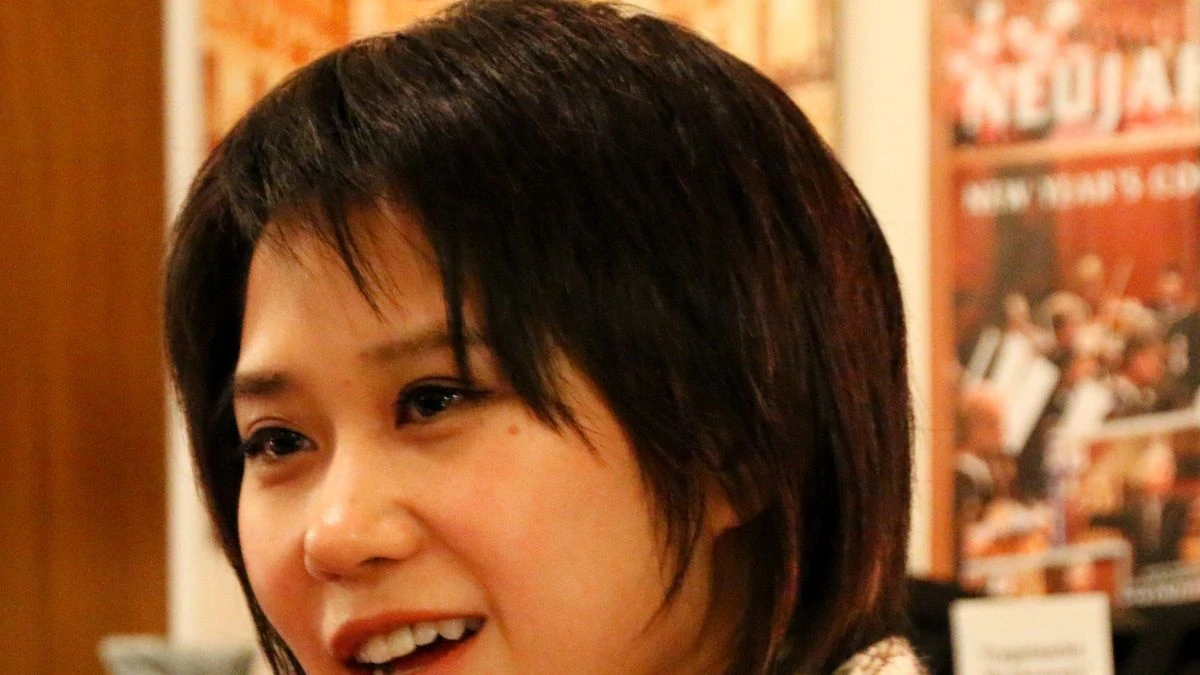
Yuja Wang.
Yuja Wang.
Audiences at Yuja Wang’s six Japanese recitals in June did not know what she was going to play when they took their seats. The programme was announced on the day, at every venue, and not before.
Her reason is short and it is the whole argument. “I firmly believe every program should have its own life, and be a representation of how I feel at the moment.”
Six Halls, No Repertoire Given
KAJIMOTO listed the run: Hibiki Hall in Kitakyushu on 6 June, The Symphony Hall in Osaka on the 8th, Yokohama Minato Mirai Hall on the 10th, Takasaki City Theatre on the 11th, Toyota City Concert Hall on the 13th, and Suntory Hall in Tokyo on the 15th.
The programme line against every date read the same: to be announced on the day of the performance. For a classical recital that is close to a provocation. Audiences buy tickets months ahead on the strength of repertoire, and reviewers plan around it.
What it buys her is the freedom to be a different musician in Osaka from the one she was in Kitakyushu two nights earlier. Announcing a programme in January locks a player into a set of decisions made by someone who no longer exists by June.
No Interval, No Applause
The recitals also ran without an intermission, and the audience was asked to refrain from applauding between pieces, so that the connections between works and the flow of the performance held. From the Yokohama date onward, photography and video were prohibited through the programme, the encores and the curtain calls.
Taken together those three rules describe a specific ambition: the recital as one continuous object rather than a sequence of items. Applause between pieces is a convention that resets a room, and removing it means one piece can bleed into the next without the audience being invited to grade each one.
It is a demanding request to make of a paying audience, and it only works if the player has the standing to make it. Wang does.
The photography ban from the Yokohama date onward suggests the earlier concerts taught somebody something. Restricting cameras during encores and curtain calls, not just the programme, points at a hall trying to protect the same continuity the no-applause request is designed to create — the piece does not end when the last note does.
Six concerts in ten days is also a punishing schedule for a recital tour, where the player carries the whole evening alone. Doing it without an interval removes the one point where a pianist normally gets twenty minutes off their feet.
The Concertos Nobody Else Programmes
Her 2026 concerto schedule was not the usual circuit of Rachmaninov and Tchaikovsky. Miami Living lists the year: the Ligeti Piano Concerto in Barcelona in January with the Mahler Chamber Orchestra and Fabien Gabel, paired with Chopin’s First.
Then Rautavaara’s First Piano Concerto with the New York Philharmonic under Thomas Adès in January, Prokofiev’s Second with the Los Angeles Philharmonic under Adès in February, and Prokofiev’s Second again with the London Symphony Orchestra and Tarmo Peltokoski in March.
March also took the Rautavaara to Rome with Santa Cecilia under Teodor Currentzis, and then across Europe with the Swedish Radio Symphony Orchestra and Esa-Pekka Salonen — Stockholm, Hamburg, Berlin and Brussels — with Prokofiev’s Second, the Rautavaara and Ravel’s Concerto for the Left Hand rotating through the programmes.
Ligeti and Rautavaara are not repertoire that fills halls on their own. A soloist of Wang’s box-office weight programming them repeatedly is spending capital deliberately, and the orchestras accepting is a measure of how much she has.
Playing the same concerto with four different orchestras and three different conductors inside a month is also a specific kind of study. Prokofiev’s Second went to Los Angeles, London, Stockholm, Hamburg, Berlin and Brussels between February and March, which is enough repetitions for a soloist to learn what the piece does rather than what one reading of it does.
The Ravel Concerto for the Left Hand appearing alongside it is the sharper juxtaposition. One is among the most physically demanding concertos written for two hands; the other was commissioned by a pianist who had lost one. Putting them in the same programme is an argument about what a piano can be made to do.
Leading From the Keyboard
Between 21 April and 3 May she toured the United States with the Mahler Chamber Orchestra as both pianist and leader — Prokofiev’s Second, the Chopin concertos and Tsfasman’s Jazz Suite. Deutsche Grammophon lists her as an Artistic Partner of the orchestra.
Directing a concerto from the piano is how this music was performed before the conductor became a separate profession, and it is a very different job from playing under someone else’s beat. The soloist has to hold an ensemble together while executing the hardest part in the room.
She went further in July, conducting in Boulder, Colorado — the Barber Piano Concerto. A pianist of her generation stepping onto the podium is a career shift rather than an experiment, and it is worth watching what she programmes when she is the one choosing for everybody.
Shostakovich in Boston
The recording side of the year rests on Shostakovich: The Piano Concertos; Solo Works, released on 2 May 2025 and issued in March 2025 as part of the Boston Symphony’s Shostakovich anthology. Andris Nelsons conducts.
The disc pairs the First Concerto in C minor and the Second in F major with six Preludes and Fugues selected from Opp. 34 and 87 — the concertos framed by the solo writing, which is a more thoughtful piece of programme-building than a straight coupling.
The Financial Times found the results “delightfully playful, quick to register variety”. Playfulness is the right register for the Shostakovich concertos, which are frequently over-solemnised by pianists reaching for tragedy the scores do not ask for.
From a Cancellation to Two Brahms in One Night
Wang’s career began with somebody else’s absence. In March 2007 she replaced Martha Argerich with the Boston Symphony Orchestra in Tchaikovsky’s First Piano Concerto, and the international breakthrough dates from that night. She signed exclusively to Deutsche Grammophon in January 2009.
The preparation behind it was long. Piano from the age of six in Beijing, the Beijing Conservatory, a move to Canada in 1999 for the Morningside Music summer programme, the youngest student ever at the Mount Royal Conservatory, then Gary Graffman at Curtis, graduating in 2008.
Deutsche Grammophon’s summary of her own position is the sentence that connects the recitals to everything else: she believes technique should never be an end in itself, and should always serve emotional expression. Withholding a programme until the morning of a concert is that belief taken to its logical end.
October brings Brahms’s First and Second Piano Concertos across two nights in Rotterdam with the Rotterdam Philharmonic and Peltokoski, and a Los Angeles Philharmonic date at Walt Disney Concert Hall on the 1st. Two Brahms concertos in consecutive evenings is the most conventional thing on her calendar and still an enormous amount of music.
The through-line is preparation rather than spontaneity, whatever the day-of announcements suggest. It is the same discipline that had Cécile McLorin Salvant spend four years reaching a two-day session — the freedom to decide late is bought by having everything ready.
About The Author