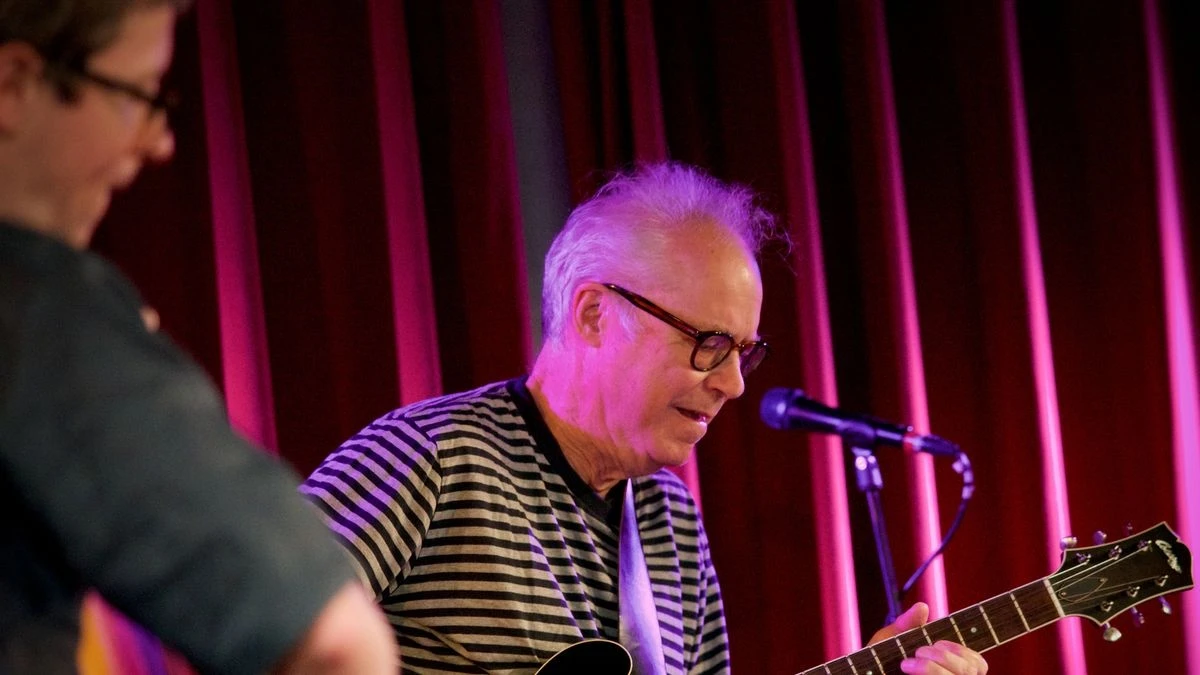
Bill Frisell performing with his trio in Tilburg.
Bill Frisell performing with his trio in Tilburg.
Decades ago Bill Frisell dreamed he walked into a darkened building and found hooded figures waiting. “We want to show you what things really are,” they told him. “First, we’d like to show you what colors really look like.” Then they moved on to music.
He has been chasing that sound ever since. In My Dreams, released through Blue Note on 27 February, is the closest he says he has come — and the first record to put the six musicians on it in the same room together.
The Dream in the Library
Frisell’s account of what happened next is unusually physical. “It felt like some sort of tube was going into my forehead and moving around, and it was the most incredible sound I’d ever heard,” he told Blue Note. He heard everything from Nino Rota to Jimi Hendrix in it, and every part was crystal clear.
A dream is a thin foundation for a career, and Frisell knows it. What matters is that he has treated it as a target rather than a story. “There have been times, over the years, where I’d be playing with these guys and it felt like I was approaching that dream.”
Naming the album after it is therefore not whimsy. It is a claim that this particular group, on these particular nights, got nearer than usual — which is a considerably more precise thing to say about a record than most artists manage.
Twelve Tracks, Mostly Live
The sequence runs “Trapped in the Sky”, “When We Go”, “In My Dreams”, “Isfahan”, “Give Me a Home”, “Why?”, “Curtis (A Year and a Day)”, “Hard Times”, “Again”, “Small Hands”, “Never Too Late” and “Home on the Range” — sixty-two minutes, nine originals and three covers.
Seven of the twelve were captured live, at Firehouse 12 in New Haven, Roulette Intermedium in Brooklyn and the Newman Center in Denver. The studio work was done at Opus Studios in Berkeley in February 2025. Lee Townsend produced.
Recording a chamber-jazz record in front of audiences and then filling the gaps in a studio is an unfashionable method, and it accounts for the album’s particular quality. The performances have the risk of a concert; the assembly has the care of a session.
The venues chosen say something too. Firehouse 12, Roulette and the Newman Center are listening rooms rather than clubs — places where an audience sits still and a cello can be heard without amplification fighting it. A group with three string players cannot work a noisy room, so the touring and the recording had to be the same decision.
Only the opening track, “Trapped in the Sky”, carries no loops. Frisell has spent decades building live guitar loops into his playing, and beginning an album about a dream with the one piece that has no layering is a quiet way of clearing the ground before the rest arrives.
Strings That Will Not Stay in Their Places
Jenny Scheinman plays violin, Eyvind Kang viola and Hank Roberts cello, and Frisell’s instruction to them was essentially to ignore the hierarchy. “Everyone is shifting their roles constantly, especially the strings,” he said. “Whatever’s on the bottom doesn’t necessarily have to be the cello.”
That is a small sentence with large consequences. A string trio playing conventionally has a fixed architecture — melody on top, foundation underneath — and dissolving it turns three instruments into six or seven possible voices.
Something Else! hears the results across the record: the strings lead on “Small Hands” while Frisell provides accompaniment and melodic markers; Kang’s viola takes charge on “Curtis (A Year and a Day)”; Thomas Morgan’s bass carries “Never Too Late” with what the review calls the pastoral grace of Charlie Haden.
A Song He Spent His Life Approaching
“Isfahan” is Billy Strayhorn and Duke Ellington’s, and Frisell’s account of finally recording it is close to reverence. “When I hear his music, it’s like, ‘How can a human being exist on this level?'”
He waited a long time to attempt it. “I feel like I spent my whole life just touching on that song, and it took me forever to get to the point where I could actually play it.” A guitarist of Frisell’s standing admitting he was not ready for a ballad until this late in a fifty-year career is worth sitting with.
The other covers reach further back. “Hard Times” is Stephen Foster, played by Frisell with the string section alone, led by Scheinman over what the review describes as fragile, twinkly guitar. Bernard Herrmann, the film composer, is another acknowledged presence — “huge for me”, Frisell says.
Home on the Range, Twice
The album closes on “Home on the Range” and the fifth track, “Give Me a Home”, interpolates it. Frisell’s reason is geographical. “I grew up in Colorado, so that’s one of those songs that was probably somehow filtering in when I was in the womb.”
The closing version does not play it straight for long. It opens with free-jazz noodling, settles into the tune as written, then ends on a loop-imbued coda the review calls dissonant and dark. A song about a peaceful home dismantled at the end of a record about a dream is the album’s one piece of visible mischief.
“Curtis (A Year and a Day)” is dedicated to the trombonist Curtis Fowlkes, and at seven and a half minutes it is the record’s longest stretch. Placing an elegy at track seven, in the middle rather than at the end, keeps it from becoming the album’s subject.
Stephen Foster and “Home on the Range” also make a point about repertoire. Both are nineteenth-century American songs that have passed out of copyright and into something closer to folklore, and treating them with the same seriousness as an Ellington ballad collapses a hierarchy that jazz has often been careful to maintain.
Something Else! puts it plainly: on “Isfahan” and elsewhere, Frisell is seeking time-honoured gorgeous melodies without any regard for the genre they arrived in. That is the through-line of a fifty-year career, and it is why an album with a string trio, a jazz standard and a campfire song does not sound like three records stapled together.
Getting the Guys Back Together
The simplest explanation Frisell gives is the least mystical. “That was the big idea here. Like, I just want to get my friends all together and do that, you know?”
The friendships are old. The string players go back decades — the three first appeared with him on 1987’s Lookout For Hope — and Morgan and Royston are his working trio. “Throughout all these years, this group has just been sort of popping up as my guys,” he said. “I went off in a bunch of different directions, and then it just came to me how much I was really missing those guys.”
He is unromantic about what a band actually is. “On the road, the concert takes a couple hours, but you’re together for days before that and after. We’ve spent a lot of time in airports.” The playing on this record is downstream of the airports.
Critics have largely agreed it worked. The album holds a Metacritic score of 78, with four-and-a-half stars from AllMusic and All About Jazz, eight from PopMatters and five from UK Vibe, which called it a fitting celebration of a musician whose influence is as profound as it is quietly worn. Mojo dissented mildly, finding the path familiar to old admirers.
That objection is fair and beside the point. Something Else! calls it “the most ‘Frisell’ of Bill Frisell albums”, which is precisely what a record made to reach a fifty-year-old dream ought to be. It is the same instinct that had Cécile McLorin Salvant spend four years preparing a two-day session — the work happens long before the tape rolls.
About The Author